Social media marketing vs content marketing is a choice many business owners struggle with. If you have a business, you’ve probably asked yourself which one is worth focusing on more.
This is an inevitable and tough choice that businesses of all sizes must make daily. Do you concentrate on increasing the number of people on your Instagram and Facebook pages? Would writing blog posts and guides be a more effective way of reaching out to customers?
Let’s keep this as simple as possible in this guide. You’ll know precisely where to put your Focus to obtain the best results.
Let’s explore the difference between the two marketing strategies. We’ll see how they can assist your business. Also, how they can work together to acquire more new clients.
Social Media Marketing (SMM) – What is it?
- Viral Potential: Creative campaigns can spread very quickly, increasing your reach.
What is Social Media Marketing?
Social media marketing (SMM) is the creation of content and sharing it. They carry this out on platforms including Facebook, Instagram, LinkedIn, TikTok and X (previously known as Twitter). The objective is to engage people, raise awareness, and drive traffic and/or sales.
Upgrades are not only for updates. It’s all about content that is suitable to the platform. This is by involving in face-to-face communication and using paid ads to attract the right audience.
The Main Characteristics of Social Media Marketing are:
- Instant interaction: Engage your viewers on the spot via messages, comments, and live streaming.
- Lead generation: Generate leads worth billions across the globe. There will be 5.4 billion social media users by 2025.
- Community building: Customer loyalty and advocacy: establishment of a sense of belonging.
- Viral Potential: Creative campaigns can go a long way and go viral fast, and widen your reach.
What is Content Marketing?
Content marketing is a very general approach. Its emphasis is on the development and maintenance of valuable, relevant and consistent content. This content is designed to capture and engage a particular target group. The goal is to build trust and authority in order to eventually drive profitable customer actions.
The Characteristics of a Content Marketing Campaign
- Quality content will outlast the season. It can still catch and educate the audience long after it has been published.
- SEO benefits: If the content is optimized, it will have a positive effect on the search engine optimization, leading to an increase in organic visitors to your website.
- Authorities building: When people share knowledge, the brand appears to be an expert in the field.
- Lead nurturing: Content guides prospects through the buyer journey – awareness to conversion.
Key Differences Between Social Media Marketing and Content Marketing
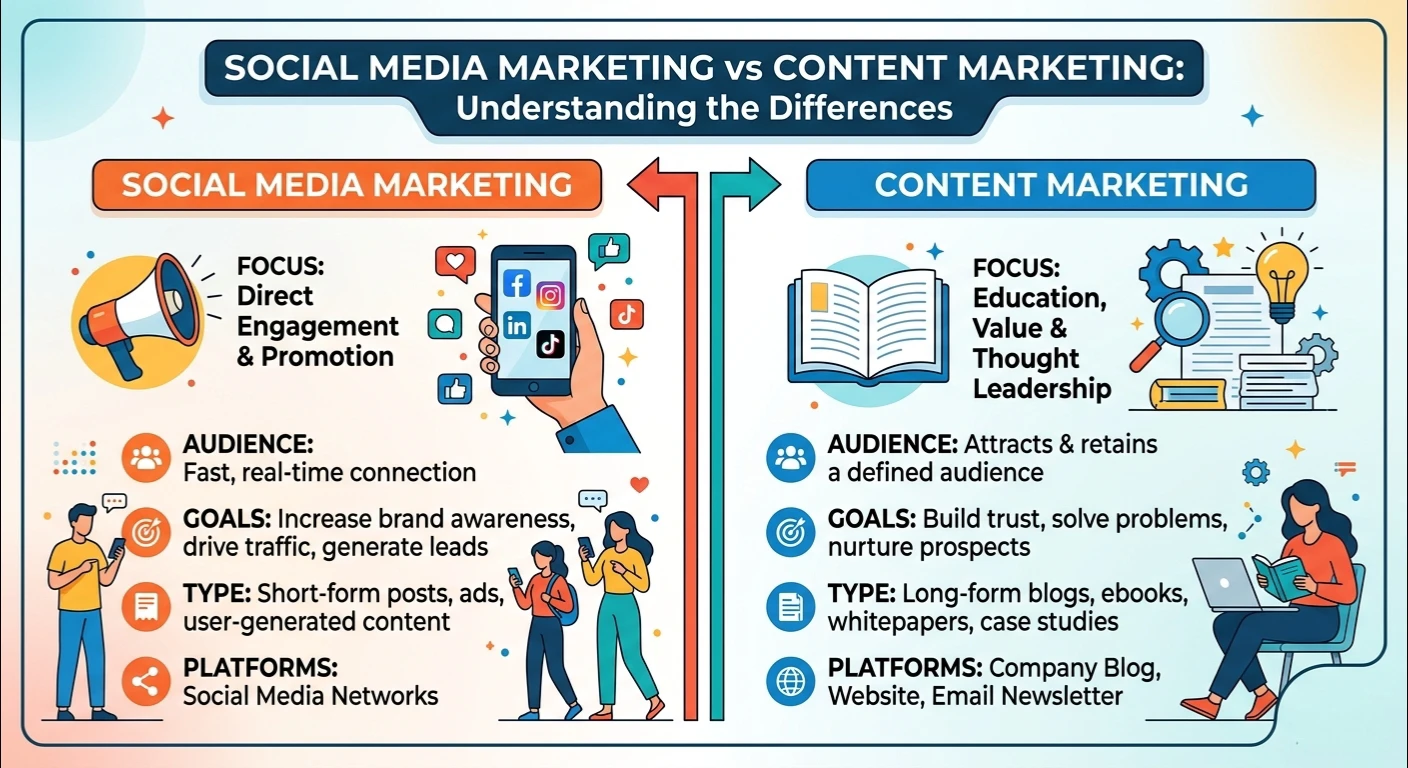
Here are the main differences between social media marketing and content marketing.
| Social Media Marketing | Content Marketing | |
| Main Goal | Brand awareness, engagement, reach | Authority, long-term reach, and SEO |
| Content Strategy | Trend-driven and short span | Evergreen |
| Distribution | Social platforms(Facebook, Instagram, X, etc) | Website, Blog, email |
| Audience Interaction | Two-way communication | One-to-many, educational, and nurturing leads |
| Analysis | Followers, comments, likes, reach | Traffic, rankings, leads, conversions |
| Preferred for | Great for community building and feedback | Building trust and long-term growth |
Benefits and Challenges of Social Media Marketing and Content Marketing For Small Businesses
Let’s talk about the challenges and benefits of social media and content marketing for small businesses. This will help you make a smart choice.
Social Media Marketing: Pros and Cons
Benefits
- Financial feasibility of commercials: Get high coverage through low budgets.
- Direct contact: Forge relationships and communicate with your customers instantly.
- Brand recognition: More than half of the customers learn new brands on social media.
- Viral potential: Viral content can generate your channel quickly.
Challenges
- Time-consuming: It is time consuming as it needs frequent posting and community management.
- Algorithm updates and platform changes may affect your exposure.
- Reputation management: A bad image may take no time to spread.
- ROI tracking: Direct purchases on social media may be a difficult process.
Content Marketing: Pros & Cons
Benefits
- Organic traffic and SEO: SEO traffic and ranking can also be increased by regularly publishing content.
- Cheap: Content marketing is 62% lower priced than conventional advertising and produces 3 times as many leads.
- Power and credibility: Content that positions you as an expert, giving your brand power.
- Lead nurturing: Nurtures and leads the prospects through the sales funnel.
Challenges
- Time and effort requirements: Quality content production is a time and effort consuming process.
- Differentiating: The online is saturated; different valuable content is mandatory.
- Knowing what Google algorithms, ranking factors and search intent matters is of great importance.
- ROI Measurement: If you do not have proper tools you can be challenged with ROI Measurement: Attribution.
How Social Media and Content Marketing Work Together
The most successful brands do not choose to dwell on one of these two strategies, but use a combination to achieve the maximum effect. Here’s how:
- Social media encompasses blog posts, videos, and infographics. These are awesome to share on social media. They can make repeat visitors of those who visit your site.
- The amplification factor of social media takes place. It enables you to share your content, discuss, and communicate much more conveniently.
- Feedback loop: Social media allows you to get feedback regarding what is preferred. You can employ this to decide future post topics.
- SEO synergy: A post on the social platform may boost the visibility of the content. It can also offer backlinks, which promote good performance of SEO.
Content Marketing Strategies
- Make a definition of your audience: create detailed personalities and address their grievances.
- Identify specific targets: Do not disregard business goal concerning content and employ the KPIs.
- Put quality first: Buy educational, valuable and original material.
- Build greater diversity: Target other groups of people with blogs, videos, infographics, podcasts, and so on.
- Diminish its impact on SEO: research keywords, on-page recommendations, and internal linking.
- Be punctual: Give a schedule in which to post regularly.
- Repurpose content: Enhance investor value and deploy through multi-channels through content adaptation.
FAQs
1. How long can you expect to see progress with regard to social media and content marketing?
Social media also yields immediate response in participation and take note. Compared to it, however, content marketing is a long term investment. It is advantageous in the long-range, such as recurrent traffic and leads.
2. Is content marketing a new name of social media marketing?
It is a process of content marketing. It relies on doing something useful such as a blog post or video. This content is in a way that will capture your target audience.
Social media marketing involves the usage of interactive posts to advertise. It is also favorable in connecting with the audience on a particular platform.
3. Which one should you focus on more?
It really comes down to what your business is trying to achieve. If you want people to discover you quickly, interact with your brand, and engage with your posts — social media marketing is the stronger choice for that. But if your goal is to build something that lasts, rank on Google, and earn the trust of your audience over time — content marketing is what gets you there. Most successful businesses do not pick one over the other. They use both together because each one makes the other stronger.
4. How does both strategies benefit SEO and online growth?
Content marketing is directly related to SEO. If you post blogs and web pages with the proper keywords, search engines will rank them and they will naturally bring visitors to your website. Leveraging social media to do this can help boost your content reach, generate shares and increase web traffic. Together they create a robust online footprint that not only attracts more customers to you but also gets you more customers on your own.
Final Words
In conclusion, the social media marketing is fabulous in maintaining real-time, building brand name, and community. This leads to sustained growth, authority and traffic of organic origin.
What actually works are organizations where two things are combined. They employ content to inform and develop. They also use social media to amplify and engage.