Building a business online store that customers want to shop from is a crucial part of B2B ecommerce development.
Consider the common way that a procurement manager purchases. She doesn’t do a little shopping for silly reasons. She has a list of 40 items, a budget approved by finance, a negotiated price and a deadline. It’s highly likely that she will find another supplier that does not require her to call a sales representative in order to place another order for her website.
This is the crux of B2B ecommerce development. There are some important differences between selling to businesses and selling to consumers who have larger carts. These buyers are different, the pricing structure is different, the process of each order is much more complex. A fine construction takes account of all that.
Why B2B Is Different?
A consumer store is designed around impulse, finding and speedy check out. B2B online store is all about repeat customers, accuracy, and trust. The buyer understands what he/she wants. They require quickness, transparent pricing, and a process that is suitable for their business.
In some industries, orders are bigger and fewer; in others, orders are very repetitive. There can be multiple parties within the same company involved, from the one who requested the product, to the one who signed it off. Traditional payment terms, not necessarily CC. None of these are that well managed by a standard retail template, which is why there’s a B2B ecommerce solution.
Choosing a Platform
Your B2B ecommerce platform is the foundation, it’s worth taking your time over. Some companies begin their SaaS offering with B2B capabilities natively integrated. Some require enterprise ecommerce development because their catalogue, pricing rules or workflows are too complex for off-the-shelf products.
There are a couple of questions that can help narrow it down:
- What is the number of products and customers you will be dealing with?
- Need custom pricing and approval workflows?
- What type of systems do the store need to be connected to?
- What will be the rate of growth in the business during the next three years?
Do not choose a product because of its list of features. Inquire about the extensibility of the platform, since there are always changes in requirements after a product launches.
Customer Portals
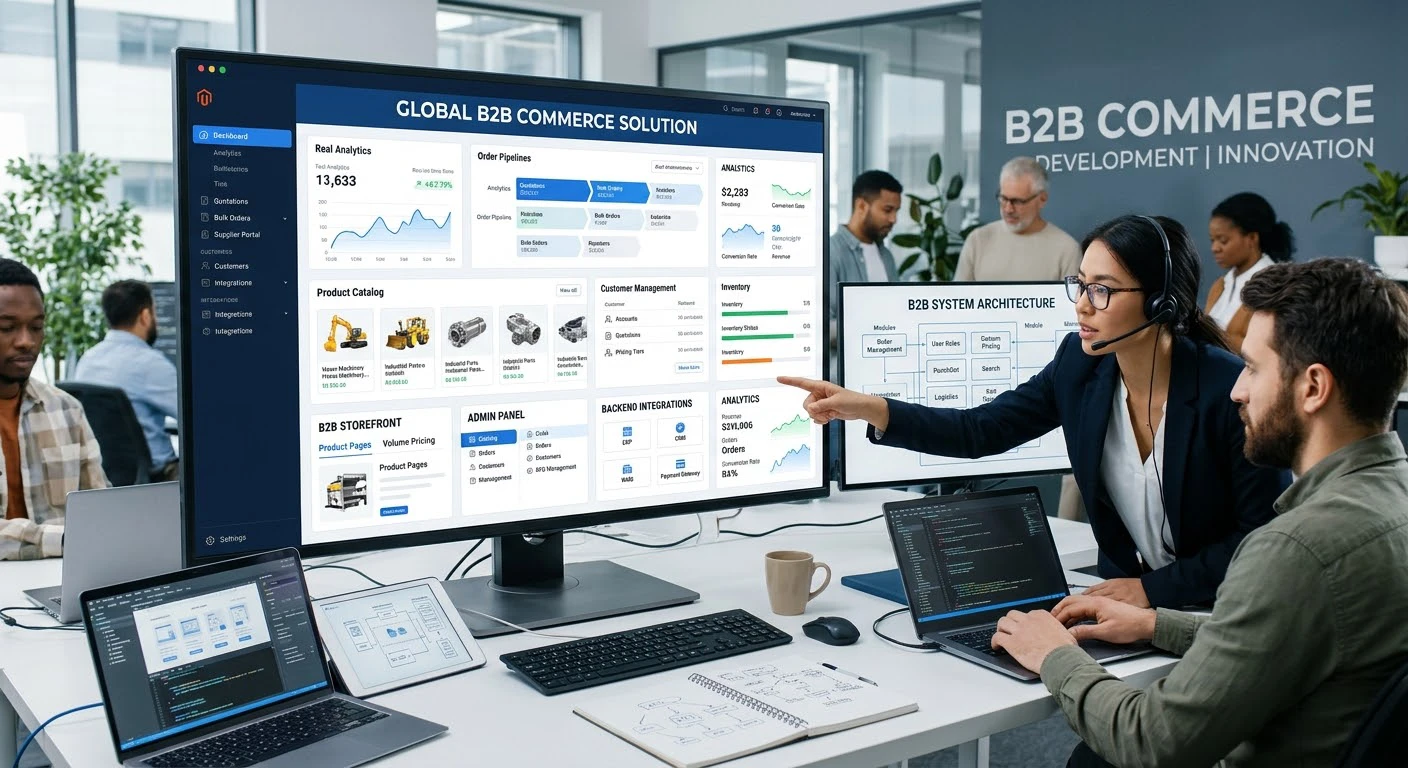
Having a solid customer portal is what frequently makes the difference between an effective B2B store and a simple catalog. Buyers logon and view their own prices, past orders, invoices, saved lists and delivery status. They can reorder in a few clicks, rather than emailing a PDF.
This is where wholesale ordering can truly be made easier. A self-service portal eases the burden on your sales and support departments, and allows customers to take control of their experience. For many businesses, it’s worth the entire endeavor.
Planning a B2B Online Store?
Our team builds custom customer portals, bulk ordering and ERP-integrated B2B stores.
Explore Our E-Commerce SolutionGet Pricing Right
The devil is in the details of pricing—in B2B. Some customers may receive a contract price, while others may receive a volume discount, and still others a specific price for certain products. AAP allows you to set prices by account. There is a tiered pricing structure which incentivizes people to buy more. The customer-specific pricing and other custom pricing rules ensure that each buyer gets the number he/she actually agreed to.
This is an expensive mistake to make. When you display the incorrect price, you lose out on margin or you’re in an uncomfortable situation with a valuable client. Beware of pricing logic before going to market and use real examples from real accounts.
Bulk Orders and Accounts
Business buyers typically don’t place orders for a single product. They save hours with bulk ordering capabilities such as quick order forms, CSV uploads, saved shopping lists and one-click reorders.
There are the people, too. There are often multiple users that have varying needs within a single company account. Multi-user accounts and role-based access allow one buyer to place orders, one manager to approve those orders and one accountant to look at the invoices, all in the same company profile. The spend levels and approvals processes help to ensure that spending remains manageable without slowing everyone down.
Catalog Management
For B2B companies, product catalog management is more important than it might seem. Technical specifications, several variations, minimum order quantities, unit conversions, and compatibility information are common characteristics of items. When data is not clean, the buyer will not trust the store.
Maintain uniformity, completeness, and adjust ability with regard to product information. If the catalog begins to get large, a product information system can be useful. Good search and filtering is also crucial. Knowing a part number, the buyer instantly finds it.
ERP and CRM Integration
This is what is going to make or break a project. Your store ought to be not an island. ERP integration ensures that prices, stock and orders are always in sync with your back office. With integration of CRM in your sales process, you can make sure that your sales team has a comprehensive view of the customer’s activity. Payment gateway integration works with the payment methods that your customers prefer, such as card, bank transfers or invoicing for terms or conditions.
Good ecommerce integration relies on solid ecommerce API integration. With a well-designed API, systems can reliably share data without having to copy numbers from one spreadsheet to another. As your inventory management system automatically adjusts as you sell products, customers are not ordering your products that you can’t ship. With order picking directly to fulfillment, fewer errors can get through.
Plan integrations early. These tend to be the most time-consuming aspects of the build, and are an easy thing to underestimate, leading to late completion of projects.
Automation
Ecommerce Automation transforms repetitive tasks into background processes. Consider things like auto order confirmations, low stock alerts, quote approvals, invoice generation and reorder reminders. B2B sales automation takes it one step further by assisting sales reps in concentrating on interactions, not information entry.
Do the most time consuming tasks first. It’s not necessary that you should automate everything from day one. Sometimes, the greatest results come from a select few carefully selected workflows.
Headless Commerce
Headless ecommerce allows you to separate out the front end and back end, the two elements of ecommerce. From there, your team can build a quick and scalable website, while your platform has products, pricing, and orders managed via APIs.
It works well if you want a custom solution, more than one location or you want to be on more than one channel from mobile apps to portals and even kiosks. It isn’t right for everyone, though. Headless setups require more development and maintenance work, so don’t pretend you need it.
B2B Marketplace
The idea of a single brand store is extended further in a number of companies by seeking to develop a B2B marketplace, where several sellers sell their products to several buyers. That introduces all sorts of complications: vendor onboarding, commission rules, split payments, and dispute resolution. If this is your path, then regard it as a project on its own, and design it around the architecture.
Web Development Basics
Even all the best advanced features in the world won’t help if the site is slow and unpopular. Even though there are so many new web development trends, the basics of fast page loading, a simple mobile experience, clear navigation, secure checkout and accessible design still hold true with strong B2B web development. There are plenty of users who order from a phone on a warehouse floor or out in the delivery truck, so mobile is at play here as well.
Security is a special concern. You’ll be working with company information, pricing for contracts, and payment information. Proper authentication, encryption, and regular testing.
Project Approach
To embark on the project in a realistic way. In large-scale builds, teams go wrong when they attempt to do too much. A more reliable route looks like this:
- Begin with discovery – interview customers and salespeople, and sketch a picture of how sales orders are actually conducted today.
- Make a list of the essential characteristics of the initial release.
- Decide on your platform and plan integrations.
- Test, refine, and create new, with real customers, and fix the things they have problems with.
- Get started, measure, and make improvements regularly.
View the launch not as the end, but the beginning!
Final Thoughts
When it comes to B2B ecommerce development it’s all about simplifying business transactions for your business. It will involve the right platform, the correct pricing, seamless integrations, and a portal to save your customers time. This also involves listening to the users of the system each week.
Make them right and your online store is no longer a nice-to-have. It turns into among the most dependable means to increase income, save handbook effort, and maintain customers loyal.