Nowadays, the concept of keyword stuffing on a website isn’t working anymore. Search engines have gotten better at understanding the context, topics, entities, user behavior and intent of a search query. This means businesses must have strategies in place that can adapt to the ever-evolving search trends, new algorithms, competitors and customer expectations.
Dynamic SEO is all about continuous tweaking of a website, and not an one-off project. It integrates search data, content performance, user intent, technical enhancements, and continuous content updates to boost organic visibility.
These measures can collectively drive improved outcomes for businesses, such as increased organic traffic, maintaining content relevance, and building a strong base for sustained search engine presence.
What Are the Most Dynamic Organic Search Marketing Techniques?
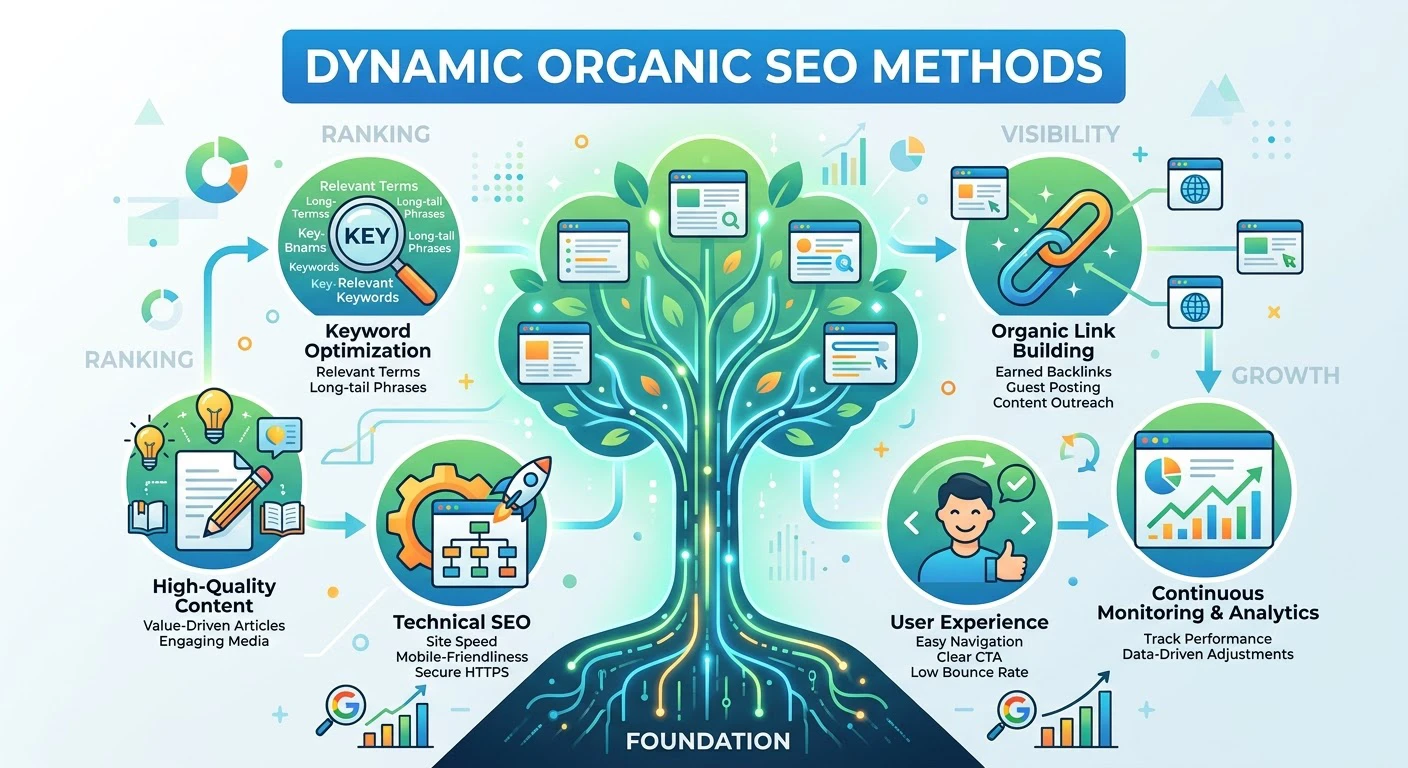
Dynamic organic SEO methods are those methods of SEO that adjust themselves to the changes in search behaviour, website performance, trends in the industry and search engine algorithms.
The classic SEO process involves the following steps: keyword research, writing content, optimizing pages, posting content, and then measuring the page rank. Dynamic SEO starts this process with an ongoing optimization cycle.
This includes:
- Tracking search queries and organic traffic.
- Updating outdated information.
- Finding new long tail keywords.
- Enhancing the content for search intent.
- Building topic clusters.
- Strengthening internal linking.
- Identifying content gaps.
- Monitoring technical SEO.
- Using data-driven SEO insights.
- Enhancing context to other topics that are related.
Is not seeking to rank for a single keyword. Its goal is to create broad topic relevance and valuable information for the ones that are searching.
Dynamic SEO is the Key to Improve Your Web Ranking
Search behaviour is constantly changing. Users’ search terms for the same solution can vary. New products and technologies, or questions and new competitors can change the search landscape as well.
In the meantime, Google search algorithms are being created to understand more than just the keywords; they are making improvements to how well they grasp the content. This ensures that dynamic SEO strategies are more useful.
For instance, an article that did well 2 years ago, might not be relevant to the questions people are asking today. The page could be more useful if it is updated to include new information, additional sections, relevant links, and updated for new search queries. So, dynamic SEO takes optimization to be a marathon and not a sprint.
Search Intent Optimization
One of the most crucial aspects of contemporary SEO is to comprehend user intent. There can be more than one meaning to a keyword, depending on what the searcher is looking for. If someone wants to know about “SEO tools” they may want to check out recommendations, comparison, pricing or tutorials.
When someone types in “how to use SEO tools,” it’s all about information. This is the reason it is paramount to produce content according to the search intent optimization. If you have an idea for a page or want to update a page, ask yourself these questions:
- Learn something.
- Compare products/services in order to determine the value of the product/service.
- Visit another particular site.
- Solve a problem.
- Make a purchase.
- Complete a task.
When the intent of a search query matches what the content is about, it’s easier to deliver a positive user experience.
The Role of Semantic SEO
Semantic SEO is about the meaning and connections between words, and not just exact-match keywords. Using related keywords, contextual keywords, synonyms for keywords and related search terms can help you create a complete page without having to use keywords in every sentence. This not only helps you to be a more natural writer, but it also helps you have a more natural writing style.
A writer can use a lot of words to describe a topic in detail, and natural readers will understand it, without using the same sentence repeatedly.
Building Topical Authority
A good example of how to build topical authority is to give detailed information about a particular topic if it is relevant to you. No one will have an article that has everything in it the reader wants. The best way to do this is to create a main resource to which other articles are connected.
For instance, a website about SEO could develop a core SEO guide and branch it out into a range of pages on:
- Keyword research
- On-page SEO
- Technical SEO
- Semantic SEO
- Internal linking
- Structured data
- Content optimization
- Local SEO
- SEO analytics
An organized set of pages allows visitors to easily navigate from one resource to the next that’s closely related, and search engines can understand the relationship between the pages. There are two key elements that we are going to cover in this section: Keyword Clustering and Semantic Keyword Research.
Search volume is not the only thing you need to take into account when doing modern keyword research. Each cluster of keywords is a grouping of related queries based on the topic and purpose of the query. This can display several different ways in which people are looking for the same thing.
For instance, a group of topics relating to website optimization could be:
- Website SEO optimization.
- Improve website rankings.
- Organic search optimization.
- SEO website audit.
- Improve organic traffic.
- On-page optimization.
Using semantic keyword research, supporting concepts, questions, entities and related terms can then be identified that should be included in the content. This results in a richer semantic content strategy and minimises the threat of thin pages which target just one phrase.
Dynamic Content Optimization
Dynamic content optimization refers to the continuous review of your pages and optimizing them according to their performance and search engine’s needs. Some useful information may be:
- Organic impressions.
- Click-Through Rates.
- Search queries.
- Ranking changes.
- Organic traffic.
- Conversions.
- Content freshness.
- Competitor activity.
Suppose a post receives traffic for a different query, but is a related query which isn’t covered by the actual article. It might be a good idea to add a helpful part to this question.
Likewise, if a page hides, the issue could well be that the content is outdated, it does not match the search query, it is not connected with other pages in a way which makes it visible, technical problems or better content.
Not Sure How Your Website Is Performing?
Get a free SEO audit and find out which pages, keywords, and technical issues are holding back your organic traffic.
Get My Free SEO AuditLet Our SEO Team Handle the Ongoing Work
Tracking rankings, refreshing old content, and filling content gaps takes consistent effort. Inceptial Logic builds and manages data-driven SEO strategies so you can focus on running your business.
Explore Our SEO ServicesCrawl Errors, Slow Pages, or Schema Issues?
Technical problems can quietly stop great content from ranking. Our experts will review your site’s crawlability, speed, and structured data and give you a clear fix list.
Get a Technical SEO AuditFree Download: Dynamic SEO Checklist
A simple checklist covering search intent, content updates, internal linking, and technical checks. Use it to review your own site every month.
Send Me the ChecklistReady to Grow Your Organic Traffic?
Talk to the SEO experts at Inceptial Logic and get a custom strategy built around your business, your audience, and your goals.
Get a Free Quote Contact UsContent & Programmatic SEO: Meeting the Demands of Scalable Content
There could be thousands of potential pages on large websites. Possibly, it is not possible to make all the pages by hand.
Programmatic SEO will help businesses create valuable pages in bulk and use templates with structured information.
Common applications include:
- Location pages.
- Product pages.
- Service pages.
- Category pages.
- Industry pages.
- Comparison pages.
- Use-case pages.
But size shouldn’t be sacrificed for quality.
High quality, meaningful, and valuable information is key to any effective scalable SEO content. Having many pages with very similar content, but for different keywords can lead to a poor user experience.
The aim should be to be useful and scalable, but not necessarily big!
Entity-Based SEO & Contextual Relevance
Search engines are understanding more and more about the relationships between entities and concepts. SEO can be entity based and used to define a website, a business, a product, and association, a person or a concept and its associations with other topics.
For example, if the article is about smartphones, then the author would certainly be referring to the manufacturers, operating systems, processors, cameras, displays and mobile networks. These are more semantically relevant links.
Natural language is also crucial. It’s a reflection of the changing emphasis on writing content that communicates meaning, instead of in a way that’s unnatural and overly repetitive in using keywords.
Internal Linking and Content Silos
A good internal linking strategy will link related pages within the site. Suppose you have a comprehensive SEO guideline on a webpage. The guide could be linked to articles that go into more detail about technical SEO, keyword research, content optimization, schema markup, and internal linking. This forms a logical information architecture.
Similar resources can also be grouped by topics in content silos which can be very beneficial. When these structures are used naturally, and support identification of relationships between related content, they are easier to understand for the user.
Internal linking should be checked on a regular basis as well. Linking new pages to relevant older pages and other existing content and linking older pages to useful new pages.
Structured Data & Technical SEO
Quality content isn’t a silver bullet for all SEO issues. It’s also crucial for a dynamic technique to monitor technical SEO – which encompasses:
- Crawlability
- Indexability
- Mobile usability
- Page speed
- Broken links
- Redirects
- Canonical URLs
- Site architecture
- XML sitemaps
- Duplicate content
Structured data and schema markup can also be used to tell search engines what type of information, like an article, a product, an organisation, an event and more, the web page in question is about.
Technical optimization is the foundation upon which success will be built in indexing and understanding the content of a site by search engines.
E-E-A-T and Content Quality
Useful and trustworthy information should always be the foremost concern of SEO. One of the main factors to consider regarding content quality is E-E-A-T: experience, expertise, authoritativeness and trustworthiness.
These attributes can be improved through a company by:
- Providing accurate information.
- Keeping content current.
- Using credible sources.
- Demonstrating relevant experience.
- Identifying authors (where appropriate).
- Making clear explanations of key statements.
- Transparent supply of business-related data.
Good SEO should be for the user, not for the purposes of getting them ranked.
SEO Automation and Data-Driven Optimization
SEO automation can provide more efficient continued optimization. Automation can help in the identification of:
- Broken links
- Ranking changes
- Content decay
- Keyword opportunities
- Internal linking opportunities
- Technical issues
- Search visibility changes
- Content gaps
Final Thoughts
Dynamic organic SEO strategies are a versatile answer to today’s organic search optimization. To make businesses more relevant than targeting keywords, topical relevance, optimization of the search intent, clustering of keywords, internal link, optimization of technical aspects, structured data, data-driven analysis, and freshness of the content can be optimized.