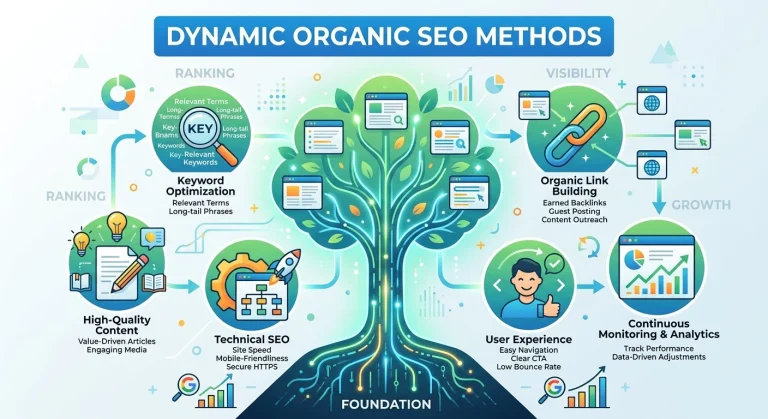

SEO content marketing in USA is a powerful tool that can boost your website’s visibility, attract the right traffic, drive organic growth, and convert leads into sales. With a competitive market in the U.S., going public with blog posts isn’t enough. Companies require a strategic approach that involves SEO, content marketing, keyword research, search intent, topical authority, and helpful content.
From small businesses to SaaS, eCommerce, professional services, or national brands, having a successful SEO content strategy can drive long-term organic growth.
What Is an SEO Content Marketing Strategy?
SEO Content Marketing Strategy is a systematic plan for producing, optimizing, publishing and promoting content to meet the needs of your users and to inform search engines about your site.
The strategy merges two essential marketing areas, namely, SEO and content marketing.
Content marketing prioritizes delivering valuable content to your audience and target market, and SEO is focused on optimizing your website for search visibility and ranking. When combined these strategies can get your content to your audience at various points in the buying process.
Some of the points that should be taken into account for a business targeting customers from the United States are the behavior of their audience, the competition, industry-specific jargon, search intent, and the U.S. audience.
Why Does SEO Content Marketing Matters in the USA?
The U.S. digital market is a competitive one. In nearly every business, companies are vying for the same search results, customers and online attention.
A well-thought out SEO content marketing strategy can aid your business:
- Improve Google rankings.
- Optimize for search engines.
- Build topical authority.
- Connect with visitors that are looking for a particular search goal.
- Generate qualified leads.
- Support brand awareness.
- Increase website conversions.
- Develop sustainable organic growth.
- Use organic methods to drive traffic from non-paid channels.
- Minimize paid advertising.
Rather than making content just to post something new, businesses need to concentrate on answering the inquiries that their possible clients are looking for.
Conduct Keyword Research
One of the pillars of a successful SEO content strategy is keyword research. But it’s not about just discovering one keyword with high volume that’s today’s keyword research.
First, determine topics, questions, problems and services for your audience.
For instance, if you are a company that provides SEO services to the United States, you would focus on phrases like:
- SEO services USA.
- SEO content marketing strategy.
- SEO content strategy.
- Content marketing services.
- SEO strategy for small businesses.
- Content marketing for local search is a local SEO content strategy.
- B2B SEO content strategy
Long-tail keywords and related keywords should also be shown. These tend to be more specific in purpose and can yield very relevant visitors.
Understand Search Intent
Search intent is the reason behind people’s search engine queries.The common types include informational, commercial, transactional, and navigational intent.
Informational intent: User wants to know something.
In the example provided above, “SEO content marketing” is the search term.
Commercial intent: The user is looking for solutions in an effort to make a decision.
For example, “best SEO content marketing agency USA”.
Transactional intent: User is prepared to act.
For instance, the term “hire SEO content marketing agency” is used.
Navigational intent: The user is searching for a specific website, brand or company.
Knowing what someone is looking for will help you develop content that meets the user’s needs rather than just filling in keywords.
Create Topic Clusters and Topical Authority
Topic clusters are one of the best methods of creating a holistic SEO content plan. Group articles together around a particular theme rather than publishing articles that are unrelated to each other.
For example, your main pillar page could be:
SEO Content Marketing USA Strategy
Additional articles that could support:
- SEO content strategy
- Keyword research
- Semantic SEO
- Search intent
- Topic clusters
- Content optimization
- On-page SEO
- Technical SEO
- Content marketing ROI
- SEO content for small businesses.
- Local SEO content strategy
- B2B SEO content strategy
These supporting pages may connect to the main pillar page and other supporting pages as they are relevant. This helps your visitors navigate your site and allows search engines to more easily determine what you are an expert in.
Make It Helpful and People-Focused Content
Any SEO plan should not try to force usability over keyword inclusion. Your content should be created with users in mind.
This includes being able to communicate clearly, give practical information, communicate in natural language, and not repeat yourself.
Rather than asking, “How many times can I use my keyword?”:
What information should someone interested in this topic be able to get from me?
For instance, if you’re looking for an SEO content marketing strategy USA, you might want to know:
- What SEO content marketing is?
- Learn how to develop an SEO Content Strategy.
- What word(s) would you like to feature in your blog posts?
- The amount of content they require.
- How to measure results?
- Do they require local SEO or national SEO?
- How does SEO content lead to leads?
- How long does it take SEO to work?
These questions should be answered in a helpful way.
Optimize Your Content for SEO
After writing your content, optimize it, but don’t sound robotic. Your main keyword may be used in the following significant places:
- Page title
- Introduction
- Main heading
- Relevant subheadings
- Body content
- Meta description
- URL
- Alt text for images (where applicable).
Yet, semantic SEO is about dealing with the larger theme rather than overstuffing it with a particular phrase. These terms help to set the context of the page in a natural way.
Utilize an Effective Content Calendar
Having a content calendar makes it easier to be consistent with publishing. On the calendar you should be able to find:
- Target topic
- Primary keyword
- Semantic keywords
- Search intent
- Target audience
- Content format
- Author
- Publishing date
- Internal links
- Content update date
- Performance metrics
In the case of an SEO company that targets the U.S., they may build a monthly strategy that consists of educational blog posts, service pages, case studies, comparison articles, FAQs, and industry guides.
Focus on U.S. Search Intent
An important part of an SEO content marketing strategy in USA is understanding the geographic market you’re targeting.
Different content strategies may be necessary for a business targeting its customers in New York than for a company serving people throughout the United States.
National businesses can target content in the following ways:
- Industry trends and issues that affect customers; Customer issues; Product comparisons; and National search terms.
- Local businesses can add local locations and questions in their content.
For example:
National:
“SEO Content Marketing Strategy for U.S. SaaS Companies”.
Local:
Creating a successful SEO content marketing strategy for small businesses in Chicago.
Geographic targeting must be relevant to the business model and customer base and not just there for ranking purposes.
Don’t Give Technical SEO the Side-Eye
Great content consists of a technically accessible website. Some of the aspects of technical SEO are:
- Website crawlability
- Mobile usability
- Page speed
- Site architecture
- Internal linking
- HTTPS
- Structured data
- Indexing
- Canonical URLs
- Broken links
Technical and Content SEO are complementary. Technical issues can stop search engines and users from effectively utilizing a website’s articles, even if they are good.
Strengthen Internal Linking
Another crucial aspect of content optimization is internal linking. If you write a new article, check to see if there are older relevant pages that can link to it. Likewise, add links from new content to authoritative pages already published on your website.
For instance, the keyword research section of your blog might reasonably connect to your greater SEO Content Marketing Strategy guide. Internal linking can guide your users to find related information and provide a logical flow within your website.
Track Results of Your Content Performance
If you want to have a successful strategy, then you must have measurable goals. Content metrics that are important for SEO are:
- Organic traffic
- Search impressions
- Keyword rankings
- Click-through rate
- Engagement
- Leads
- Conversions
- Revenue
- Backlinks
- Returning visitors
Do not evaluate a content strategy based on traffic. A page that sees 1,000 visitors but doesn’t generate any leads is worth less than a page that sees 200 highly targeted visitors that generates 10 leads.
Vanity metrics are the last thing businesses need; what they should be focused on is business results.
Review and Enhance Existing Information
SEO content marketing doesn’t end when the article is published. The search results, competition, customer questions and industry information are constantly updated. Your content should thus be checked periodically.
Look for:
- Outdated statistics
- Missing information
- New questions
- Better examples
- Broken links
- Weak sections
- New opportunities for internal linking
- Changes in search intent
It’s also crucial to keep valuable content fresh to ensure optimal organic search results.
AEO and GEO: Preparing Content for AI Search
Answer Engine Optimization (AEO) and Generative Engine Optimization (GEO) are also important strategies to consider for modern content strategies.
AEO
AEO is all about ensuring that information is easily understood and accessible to answer engines when answering questions.
GEO
GEO is more comprehensive in building the odds for your brand, expertise, and information to be understood and surface in generative AI experiences.
To create answer-friendly content:
- Provide clear answers to key questions.
- Use descriptive headings.
- Provide concise definitions.
- Structure information clearly.
- Use facts and examples that are relevant to the text.
- Demonstrate genuine expertise.
- Maintain information that is accurate and up to date.
- Include all aspects of the topic.
- Deliver a clear, natural language presentation.
For instance, don’t place the definition of SEO content marketing many paragraphs into an article, but rather make it explicit close to the start. This makes it easier for users and systems that want to know what it is.
Final Thoughts
A good USA SEO content marketing doesn’t rely on stuffing articles with keywords or creating hundreds of pages, it is about creating content that is well-thought-out and valuable. It comes down to empathetic content, knowing what your audience is looking for, establishing topical expertise, and delivering useful content on a consistent basis.
Keyword research, meaningful topic clusters, people-first content, page optimization, internal linking and business outcomes measurement. Afterwards, constantly optimize and update your content according to its performance and evolving customer demands.
The largest opportunity for U.S. businesses is integrating the concepts of good SEO and content marketing with those of semantic SEO, AEO, and GEO. If each piece of content on your site has a clear objective and is truly useful to your audience, your website can achieve improved search visibility, relevant organic traffic and long-term organic growth.