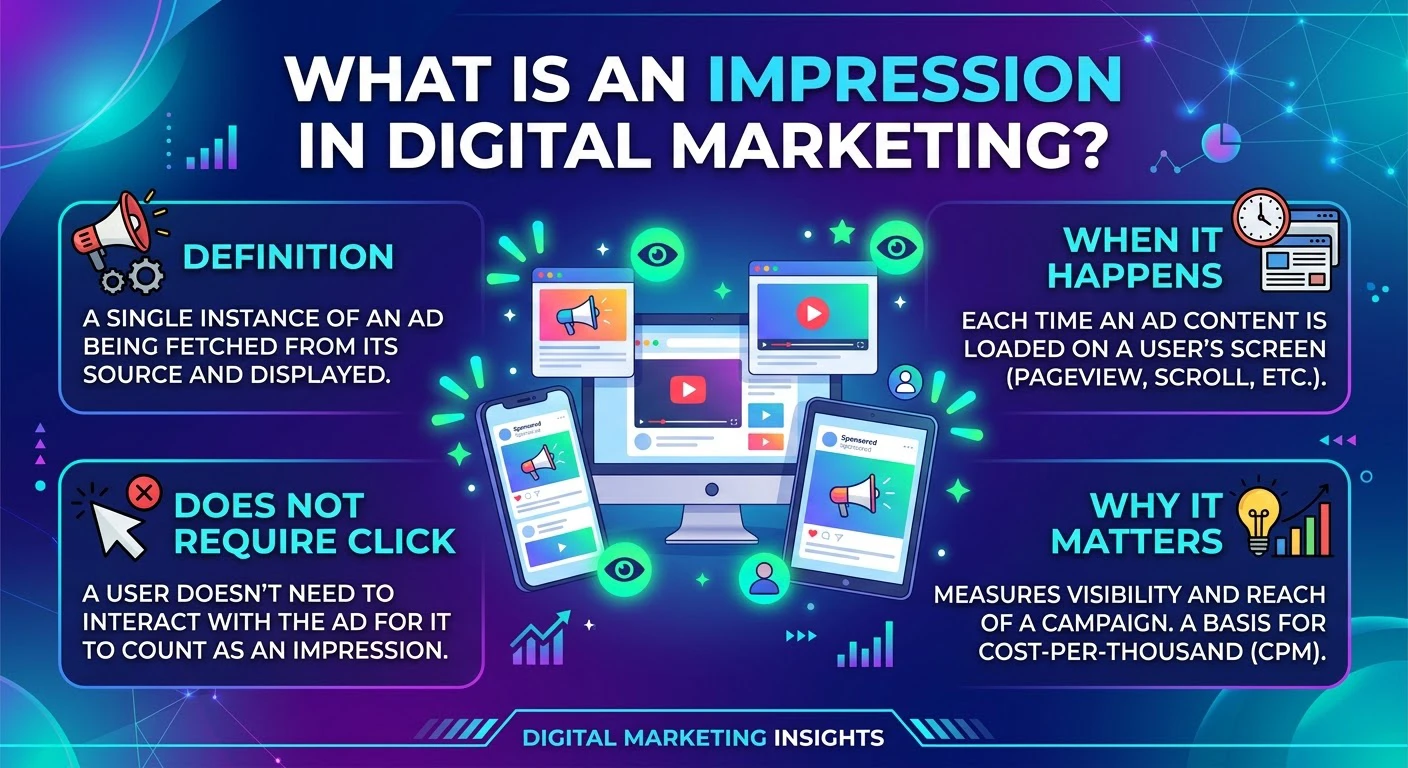
One of the most basic and essential metrics in digital marketing is ‘what is an impression digital marketing’. Impressions measure how many times an ad (or webpage or social post) appears on a user’s screen.
The user does not need to interact with it. The user does not need to click it. This is true even if the user only sees it while scrolling.
Online ads, SEO (Search Engine Optimization), and social media marketing use impressions in many ways. Impressions show how often content appears online. They also show how far it reaches across the internet.
Impression in Digital Marketing
Impression is a key indicator of brand awareness in digital marketing. A search engine, website, or social platform counts an impression each time it displays your content.
Marketing often focuses on impressions because they show what you’ve achieved: People have seen you. Repeated exposure to a brand, even when consumers do not use it, helps establish recognition and trust over time.
For instance, if your ad reaches 5,000 people on Facebook, you get 5,000 impressions. This is true even if nobody clicks your ad or takes action.
Ad Impressions Meaning
If one is looking for ad impressions meaning, they are attempting to come to terms with how digital ads are measured. An ad impression plainly and simply represents the number of times an ad appears on a page, app, or social media feed.
The system counts one impression each time an ad appears on a screen. This includes:
- Display ads on Web sites.
- Television commercials on YouTube.
- Sponsored posts on social media
- Mobile ad banners in applications
The number of ads served is not a measure of engagement, it’s a measure of visibility.
Digital Marketing Impressions Explained
The key to comprehending digital marketing impressions explained is to visualize impressions as “views” of your content.
If your ad is displayed:
- 1 time = 1 impression
- 100 times = 100 impressions
- 10,000 times = 10,000 impressions
But just because someone has seen an impression doesn’t mean they’ll see or engage with the web page. It just indicates that their screen has displayed the information.
This is why analysts often measure impressions alongside other metrics such as clicks, CTR (Click-Through Rate), and conversions.
Impressions vs Clicks
The comparison of “impressions vs clicks” is one of the most significant points to consider in online marketing.
Impressions is the number of times content is displayed.Impressions is the number of times that content is displayed. The number of clicks users interact with the content.
For example:
A 10,000 impressions ad with 200 clicks would have a 2% click-through rate.
This comparison enables the marketer to gain insight into:
- How appealing is their advertisement?
- Does targeting work effectively?
- Is targeting effective?
IF THE MESSAGE FACILITATES INVOLVEMENT
Low clicks with many impressions can mean the ads have a poor design.
It can also mean the targeting is reaching the wrong audience.
High clicks with fewer impressions can mean the audience is interested in the ads.
Impression Tracking is a Powerful Digital Marketing Tool
Impression tracking means tracking impressions, or how many times users view ads and content.
Marketers can leverage tools such as:
- Google Ads Manager
- Google Analytics
- Facebook Ads Manager
- Instagram Insights
These tools aid in monitoring:
- Total impressions
- Impressions per ad
- All questions and comments will be answered with impressions per audience segment.
- Impressions over time
That’s why it is crucial to track impressions. It enables companies to tell which ads are seeing more visibility, and which ones could use some work.
Online Ad Impressions
Online ad impressions are created as an advertisement is placed on an online platform. This involves web pages, apps, search engines, and social media platforms.
There are several categories for the number of ad impressions online:
- Served impressions: When an ad is served by the server.
- Viewable Impressions: Any ad that appears on the screen and users can see (in part or in full).
- Unique Impressions: displayed to a unique visitor
CPM (Cost Per Mille) is a metric many advertisers use. It charges for 1,000 impressions, not clicks or conversions.
Social Media Impressions Meaning
Social media impressions count the number of times users see a post or ad.
This can happen on platforms like Facebook, Instagram, X (Twitter), LinkedIn, and TikTok.
For example:
- We then count duplicated viewings (when the same user sees the same post more than once) as 3 impressions.
- Viral content can create millions of impressions in just a few days. Viral content can create millions of impressions in just a few days.
However, social media impressions matter as they assist brands in:
- Measure content visibility
- Understand audience reach
- Improve posting strategies
- Increase brand awareness
But it’s not just about impressions alone—always view impressions alongside likes, shares, and comments.
Content Impression
Impressions are vital as they are the initial step in the marketing funnel. Content is a blind before click or conversion.
There are several reasons why impressions are important:
- Build brand awareness
- Increase visibility
- Measure campaign reach
- Support retargeting strategies
- Enhance the analysis of ad frequency
Repeatedly impressioning a user can result in conversions long after the initial interaction.
Limitations of Impressions
In addition to the benefits, impressions come with some drawbacks:
- They don’t display user engagement.
- They can contain multiple occurrences from the same person.
- They are not a sales or conversion guarantee.
- They sometimes exaggerate their reports.
This is why marketers don’t just look at impressions but also take into account other metrics.
Best Practices To Make the Most of Your Impressions
Some of the ways businesses can boost their impressions in digital marketing are:
- Improve ad targeting: Utilize quality visuals and creatives.
- Optimize keywords for SEO: Increase your online presence, as you’ll be consistently there on social media.
- Conduct paid advertising campaigns.
- Utilize hashtags and topics that are popular at the time.
Improper targeting and content quality generally result in increased impressions and brand visibility.
Conclusion
For anyone working in online marketing, SEO, advertising, or other online services, it is important to understand digital marketing. If you work in online marketing, SEO, advertising, or any online service, you should know what digital marketing is. Impressions are one of the most important metrics for visibility and reach. They measure how many times people view content.
In digital marketing, an impression measures awareness. In ad terms, it counts how often an ad appears on platforms. “Digital marketing impressions explained” shows that impressions relate to exposure, not engagement.
Marketers can use impression tracking to analyze impressions vs clicks, and also study online ad impressions, and social media impressions meaning to create better, more effective campaigns.
Ultimately, impressions are the base of all digital marketing campaigns. They show how many times people see your brand. They are the first step toward engagement, trust, and conversions.