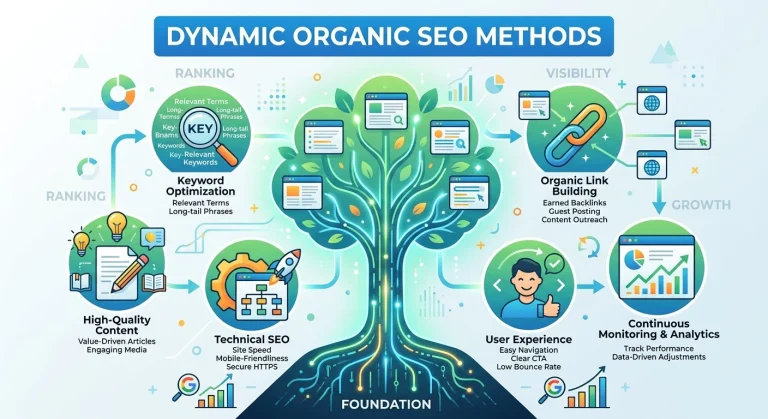
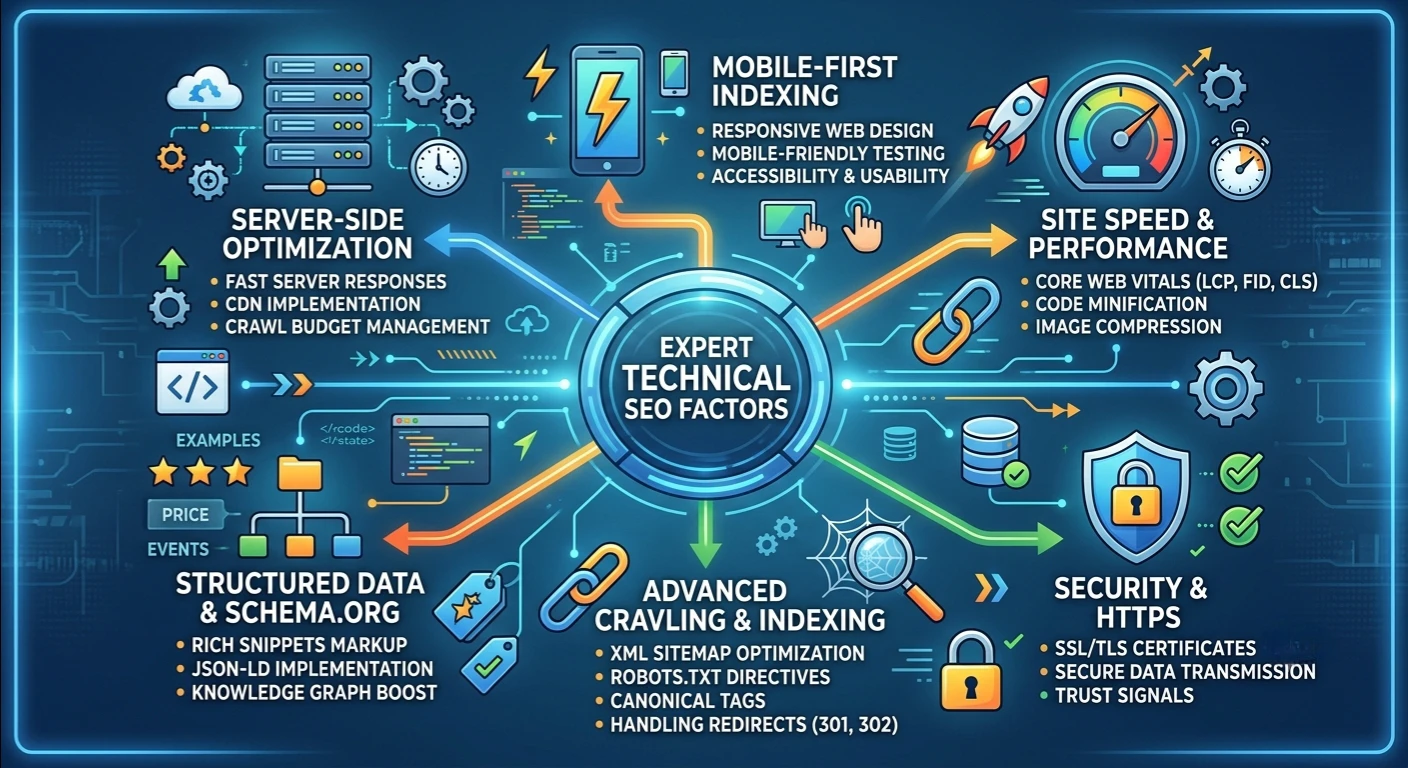
Technical SEO Factors are the key elements that can significantly improve the performance of a website.Technical SEO Factors are the various factors that can help to boost the performance of a website.
The search engines have become smarter and a good web page has more than to have quality content. Every successful site has underpinnings of a technically sound site that enables search engines to find, understand, crawl, and index the pages. That’s where the expertise of technical seo factors comes in.
Technical SEO is a type of SEO (Search Engine Optimization) that focuses on the technical elements of a website.Technical SEO is a kind of SEO that involves optimizing the technical aspects of a website. From the organization of the website and how easy it is to crawl, all the way to page speed and indexing, there are a lot of different factors that could affect a website’s performance in the search results.
Understanding these elements is crucial for website owners and SEO professionals alike, as it enables them to identify technical problems, improve the user experience, and build a strong foundation for organic growth.
What Is Technical SEO?
Technical SEO involves improving the technical aspects and performance of a website to ensure it is easily accessible and comprehensible to search engines. Technical SEO focuses on the back end of the website and is not as much about keywords and information as content SEO is.
These are the most important areas: website structure, page speed, mobile optimization, indexing, website security, URLs, redirects, and structured website navigation.
A technically optimized website makes it easy for search engine crawlers to navigate it. It also enables the user to retrieve information easily and move around the site without any hindrance.
Why Expert Technical SEO Factors Matter?
Expert technical SEO factors matter because search engines assess and analyze websites. Even if a website has great content, technical issues can prevent search engines from finding or indexing the content correctly.
For instance, if you have misinformed robots.txt directions, then significant pages may not be being indexed. Duplicate URLs can lead to a lack of clarity regarding which URL to link to in the search results. A slow page might lead to a bad impression on your visitors too.
Solving these problems will provide a better technical base and enable the content to be more effective.
SEO Website Architecture
With a well-designed website architecture, the website is easier to digest and make sense of for users and search engines.
In a logical structure, the first page will always be the home page, then categories, subcategories and pages. We must not create and place high-value pages deep within the website.
A simple architecture can enable search engines to find important content and enable visitors to navigate naturally. There should also be internal relationships of related pages that are clear.
Descriptive urls, logical categories, consistent navigation and relevant internal links are all elements of good architecture.
Website Index Ability
Crawl ability concerns whether search engines can reach the page, whereas website index ability concerns whether search engines can index the page and may display it in search results.
A crawler can access a page, yet the page can include instructions not to index it. SEO professionals should therefore consider technical signals such as indexing directives, canonical tags, HTTP status codes, and others.
Google Search Console can be helpful for pinpointing indexing issues and figuring out how search engines are indexing web pages.
Search Engine Crawling
Search engine crawling is the activity of search engine robots finding and revisiting websites.
Crawlers crawl links among pages and use “signals” like sitemaps to discover content. This is easier on websites that have good internal linking and a clear navigation.
Crawl efficiency is a key consideration for large sites. This can waste crawling resources by having unnecessary variations of URLs, duplicate pages, broken links, or pages with little value.
Keeping the website structure clean can help search engines focus on important content.
Search Engine Indexing
Once the pages have been crawled, search engines analyze the pages to decide whether to add the pages to their index. People refer to this as search engine indexing.
The quality of the content, accessibility, technical configuration and duplication are some of the factors that influence indexing.
Since search engines index most pages on a website, site owners should periodically review the indexed pages and investigate any strange exclusions. The pages that you would want to show up in search results must be accessible and properly set up.
XML Sitemap
XML sitemaps give search engines details of the key sites on a site. This can be helpful in a large website, a new website, and a complex website.
A sitemap should be a list of the URLs that site owners would like a search engine to visit and index.
It’s crucial to maintain an accurate sitemap. Avoid routinely including broken URLs, redirected pages, or unnecessary URLs.
Submitting sitemap at Google Search Console will also help website owners keep track of how search engines handle their URLs.
Robots.txt
The robots.txt file is a text file that tells search engine robots whether they are allowed or not to access certain parts of a website.
It is crucial to get it right as an unintended blocking rule may block the crawl of critical parts of a site.
Any significant changes to your website should receive careful consideration of the robots.txt file. Inbound marketing experts need to make sure they don’t accidentally lock out vital pages, resources, and areas.
Canonical Tags
If the same (or similar) content can be found on multiple URLs, then the canonical tag will inform the search engine of the preferred version of the page.
For instance, the same page content could exist in different versions, such as different URLs. To generally indicate which version you should consider the primary URL, you may use a canonical signal.
A good canonical implementation can minimize confusion and aid in the management of duplicate and/or similar pages.
URL Structure
A clean URL structure makes it both easier to use and for the search engines to understand.
A good SEO friendly URL is concise, readable and logically structured. They should explain the content of the page, without adding any additional arguments or weird symbols.
For instance, a URL that incorporates a clearly defined category and topic of the page is much easier to comprehend than one that has an excessively long URL with unrelated numbers and parameters.
Stable URLs also simplify website development throughout its growth.
Internal Linking
One essential component of technical SEO is internal linking, which connects different pages across your website.
Internal linking is the process of linking one page to another within the website that has been thoughtfully planned and executed.Internal linking refers to connecting one page to another in your site in a smart way to guide users to find related content and to help the search engines crawl from one page to another.
But you can also use internal links to build associations between key pages. Effective internal linking helps prevent the site from removing important pages from its context.
Using the appropriate anchor text can also assist users in making sense of what they should find after clicking on a link.
Advanced Technical SEO
For large websites, e-commerce, international websites and complex technologies, advanced technical SEO becomes more significant.
Advanced tasks can include crawl pattern analysis, dealing with high volume of URLs, JavaScript rendering, redirecting, URL internal linking, URL indexing and more.
It is also crucial for technical SEOs to understand the impact that changes to a site have on the crawling and indexing process prior to making a large-scale change.
Technical SEO Audits
Ongoing technical SEO analysis can be used to detect issues early, before they become significant hindrances.
An audit may include a review of:
- Crawl ability
- Index ability
- XML sitemap configuration
- Robots.txt
- Canonical tags
- URL structure
- Internal linking
- HTTPS security
- Website speed
- Broken links
- Redirects
- Server errors
By conducting these regularly, website owners can ensure they have a solid technical base.
Common Technical SEO Mistakes
There are several technical issues that can impact the performance of your website. These ranges are those where the user inadvertently prevents access to important pages, makes duplicate URLs, uses incorrect canonical tags, leaves broken links unresolved and does not redirect outdated links.
One of the biggest issues is simply neglecting to check website performance once you have installed a new feature or plugin.
Do technical SEO continuously, not as a one-off.
Final Thoughts
A sound website provides a solid foundation for content and other SEO efforts. Companies that can regularly check technical performance and solve problems as they emerge will be able to develop a website that’s more accessible, more secure, and more efficient – and better equipped for long-term success in organic search.
Transform your website into a search engine powerhouse and drive sustainable organic growth with our expert technical seo service.