Three days to script, shoot, and edit one video. You hit publish, and the result? Ten or maybe twelve views only. It’s quite annoying and it happens to pretty much every producer at some point.
It’s not always the video’s fault. However, no one can find it. Now comprehensive video seo secrets come to the rescue. Basically, video SEO (Search Engine Optimization) is the process of informing YouTube, Google and others about what your video is about so that it can be made visible to the people who want to see it.
You may need to get consistent online traffic coming to your channel, to your business, or to your educational video – knowing some video search engine optimization is vital. Which by no means has to do with stuffing keywords all over. Research, good content and observing people in practice.
What Is Video SEO?
Video SEO involves optimizing your videos in a way that helps search engines and platforms to index and rank them in the most relevant search results. For many creators, YouTube SEO is paramount, since YouTube is a video website and one of the largest search engines in the world.
The first trick in a successful video SEO scheme is prior to recording the video. Then, consider what they are entering into the search bar, what their purpose might be for typing that word and what type of video might be useful for them.
This is where ‘keyword video research’ can come in handy. Don’t use the same words or phrases too many times. Look for a batch of similar questions, words and concepts that have the same theme. These semantic video keywords, used to describe the content of your video, let you write as a normal person.
Start With Keyword Research
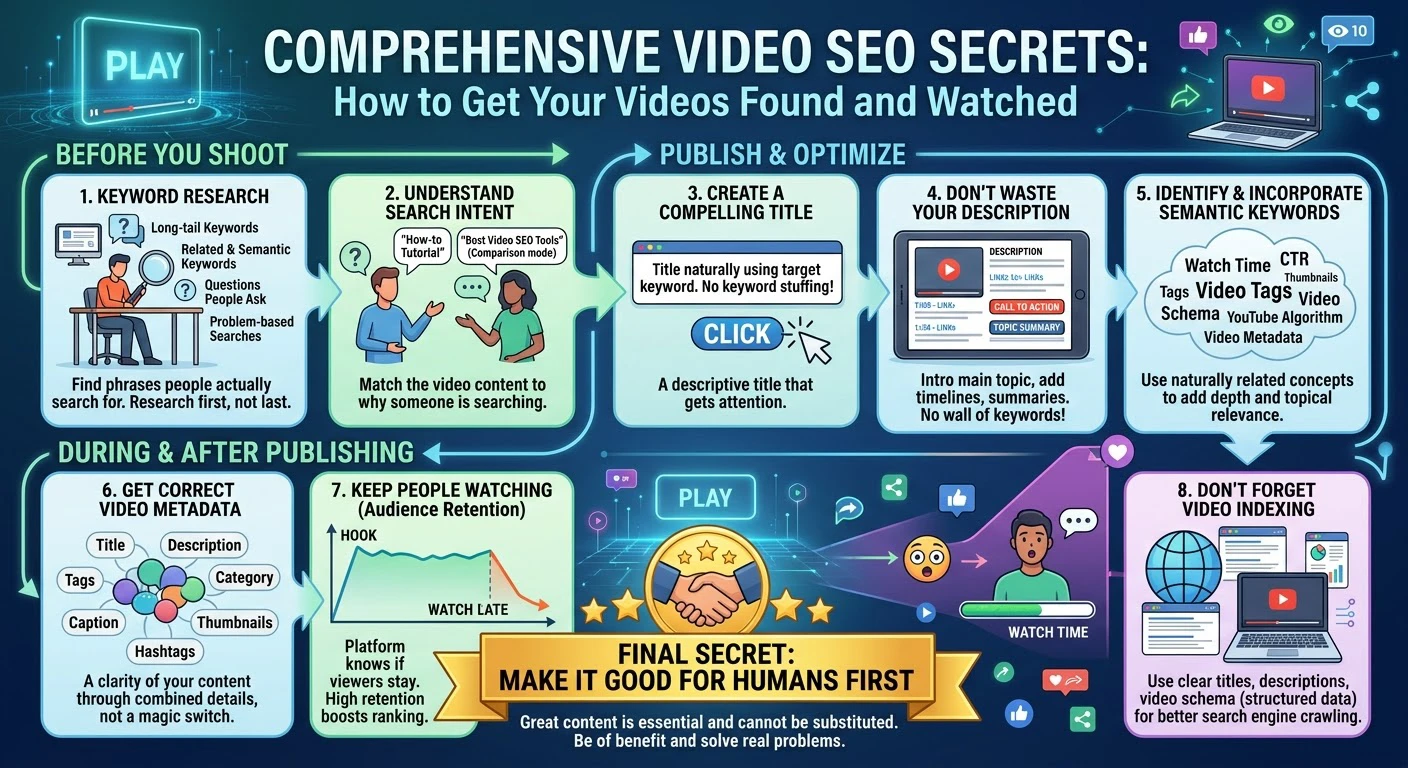
All of these detailed video seo secrets start with keyword research. You’re searching for phrases that people actually search for, and that are relevant to what your video offers.
Begin with your topic and then develop it into:
- Long-tail keywords
- Related and semantic keywords
- Questions people ask
- Problem-based searches
- Comparison searches
- Questions of information and commercial enquiry
If you’re talking about video SEO, for example. YouTube SEO tips, ranking on YouTube, video ranking factors, or YouTube description optimization would be among the related searches. All are potential video segments, if not entire videos.
Understand Search Intent
It’s a place that’s skipped pretty often in this part. A keyword is a word to identify what someone wrote. Search intent is an indicator of why.
The person who is looking for “how to optimize YouTube videos” is looking for a tutorial. People who search for the best video SEO tools are already in comparison mode and might be willing to make a purchase. The individual who typed just “YouTube SEO” is probably looking for a general overview.
Match the video with the intention. If they find what they are looking for, they will watch more, comment more, and will probably click on your next video. Those behaviors can help build a better video ranking in the long run.
Create a Title that is Compelling Enough for Users to Click
The title of your video is often the first thing a viewer will see, so giving it some thought in video title optimization is well worth it. Use your target keyword in a natural way, but don’t use the same phrases over and over in the title. No one clicks on those.
The title, “Video SEO,” says very little to me. It’s better to have a title that absolutely dispels any doubt about what I’ll learn. One question to ask yourself before you publish: Why would anyone click this?
Don’t Waste Your Description
YouTube description optimization is your opportunity to get into the details of your video. Avoid using a wall of keywords. Keep it brief but informative, introduce your main topic in the beginning, and then summarize the points.
Include timelines, useful links, and a call to action, if appropriate. A description will help the viewer see the relevance of the content, as well as search systems and the content.
Identify and Incorporate Semantic Keywords
Search has shifted from repetition of exact matches to being towards meaning. When creating a video about YouTube optimization, it is obvious that you will not miss out on talking about “watch time,” “CTR,” “thumbnails,” “video metadata,” and YouTube algorithm and audience retention. Using those keywords increases the content’s depth and topical relevance.
The point here is all about “naturally”. Bend sentences around the keyword? Don’t do it. For the people, write.
You Have Correct Video Metadata
Video metadata includes information about your video, such as its title, description, tags, categories, caption, thumbnail, and more. No one of these is a magic switch. Combined, however, these two point to a clarity of your content.
Video tags may be helpful for spelling variations and related words, but they can’t save a poor video. The same holds true with the hashtag. Some helpful ones are good, a stack of ones that have no common sense is spammy.
Keep People Watching
Click is just the beginning. One of the biggest factors for YouTube performance is audience retention. The platform knows when viewers bail out in the first few seconds. It’s aware of that if they remain.
Open with a hook. State what the video provides, avoid the lengthy introduction, and organize it so that people know where it’s going. If the video is good, then the watch time will be good – don’t fake it. Simply provide them what they seek.
Don’t Forget Video Indexing
In order to be indexed by search engines, a video needs to be understood by the engines. Video indexing is improved by clear titles, quality descriptions, video transcripts, and quality content.
If you have videos on your own website, include a video schema. Google processes this structured data and conveys information to it, such as the title, thumbnail and duration, which can boost your ranking in Google search.
Make it Good for Humans First
The bottom line in these complete video seo tricks is that great content is essential to the success of seo, and it cannot be substituted. While you can do the title, the metadata, the keywords, if the video itself is boring or confusing, or even incorrect, people will turn off the video.
Be of benefit to people and solve a real problem/answer a real question/teach something useful or give people a good time. That is something that only you can do.
Want Your Videos to Rank Higher and Get More Views?
Our SEO experts at Inceptial Logic can help you optimize your videos, reach the right audience, and grow your traffic. Let’s talk about your goals.
Contact Us TodayWrapping Up
Video Search Engine Optimization isn’t a one trick pony. It’s research, relevance, quality, and understanding your audience — all wrapped up in one.
Perform video keyword research. Understand search intent. Utilize semantic keywords in a natural way. Create a clear title and description, do an honest thumbnail and focus on retaining the audience. Then monitor your CTR and watch time, and listen to the numbers.
Also, think outside the box when it comes to video length. Continue to create related content on main topics and continue creating helpful content that really helps people. The key to good video seo is to make your videos easy to find, easy to understand and worth viewing.