Patients today don’t simply ask for a doctor’s referral from a friend — they research online, read reviews and compare options before ever calling a doctor. That’s why digital marketing in healthcare is no longer an optional feature but a necessity. From a small clinic to a vast hospital network, how you appear online can make a huge difference in your patient numbers.
From SEO (Search Engine Optimization) and content to reputation management and automation, this guide covers all the essential parts of healthcare digital marketing to ensure you create a strategy that generates patients, not just looks.
How to Earn Patient Trust Before Their First Visit?
Healthcare decisions are personal and urgent, altering the nature of healthcare marketing from everyday consumer advertising. Patients are looking for:
- Before signing up with a provider, trustworthy information first.
- Provide straightforward information in response to specific health queries.
- Evidence of a practice’s credibility, qualification and feedback.
- Once they’ve decided they can make an appointment easily.
All these needs can be served in one go with a strong healthcare marketing strategy, and by doing so, it creates a sense of trust before a patient ever walks into the waiting room.
Key Components of a Healthcare Digital Marketing Strategy
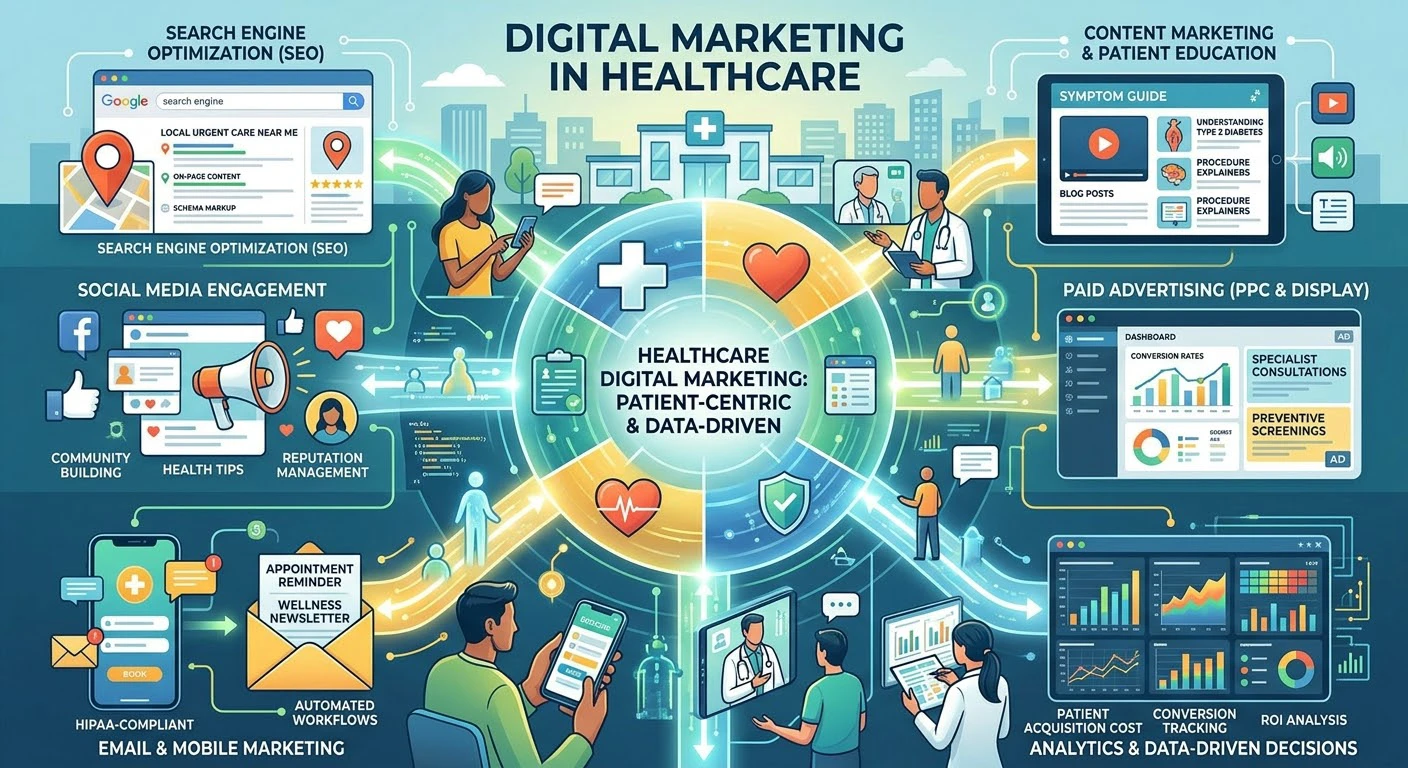
Some of the key components of a digital marketing strategy in healthcare are listed below.These are some of the core components of a Healthcare Digital Marketing Strategy.
1. Healthcare SEO
With Healthcare SEO, you can ensure your practice is visible when people look for symptoms, treatment, or health providers in their area. This includes:
- Optimize web pages for medical terms that are relevant.
- Organizing content by real patient questions
- Optimizing site speed and mobile friendliness
- Creating quality backlinks from trusted health websites
Medical SEO can be a healthcare provider’s biggest channel, as most patient journeys begin with a search engine, not a referral.
2. Local SEO for Hospitals
Local SEO for healthcare is crucial, as most patients look for medical attention near their place of residence. This involves:
- Claiming and optimizing your Google Business Profile
- Ensuring uniformity of name, address and telephone numbers throughout directories
- Encouraging and responding to patients’ reviews
- Optimizing for location specific keywords such as “specialty near me”
A well-optimised local presence can more effectively attract appointments than a national SEO campaign, as patients are seeking immediate appointments.
3. Healthcare Content Marketing
Content marketing in healthcare helps to establish trust by providing the answers to some of the patient’s questions that they already have. This can include:
- Blogs that help readers understand the symptoms and what to expect when dealing with a condition and its treatment.
- Patient education videos.
- FAQs about frequently asked questions prior to first visit.
- Access to downloadable guides to help manage chronic conditions.
- Access to downloadable guides to assist with management of chronic conditions.
In addition to boosting your SEO rankings, good medical content marketing helps to put your practice in front of people as a reliable source of information.
4. Healthcare Social Media Marketing
Patients are putting more effort into gaining information about the providers before they make a booking on social media. Healthcare social media marketing helps practices:
- Share patient stories of success (with consent).
- Share educational information in a more accessible format.
- Educate staff and the environment to create familiarity.
- Answer frequently asked questions in a public and building trust manner.
Content that is truly helpful and not just “sell” content is best suited to this channel.
5. Healthcare PPC Advertising
Healthcare PPC advertising provides immediate results for particular campaigns, like when you’re promoting a brand new service or booking appointment spaces throughout down periods, while SEO takes time to build up visibility. Social ad and paid search can be used to target patients geographically, demographically and even by specific health interests – great supplement to organic.
6. Healthcare Email Marketing
Email marketing for healthcare continues to be a great way to make sure that your current patients stay connected to you between appointments with you by doing the following:
- Reminders and follow-up information.
- Seasonal health warnings and preventive health information.
- Newsletters of new services or providers.
- Patient satisfaction surveys.
This channel is especially great for patient engagement and repeat visits for preventative services.
Optimizing Your Website is Akin to Optimizing Your Front Door
Healthcare website optimization is essential for making a first impression on your website that’s memorable for your patient. Key priorities include:
- Quick site loading times, particularly on mobile devices.
- Make services and providers easily accessible, as well as contact details.
- Make scheduling appointments an easy and hassle-free affair.
- HIPAA compliant forms of data to be collected from patients.
- If patient data is to be collected, then there are HIPAA compliant forms.
Good medical website SEO and a good user experience are tightly coupled up — a well-optimized site, but a bad user experience, will still lose potential patients at the end.
Healthcare Reputation Management
Patients rely heavily on online reviews when making their treatment decisions. Healthcare reputation management is essentially the proactive approach to managing reviews, responding to them professionally, and trying to solicit positive feedback from happy patients.
Healthcare online reputation management isn’t just about damage control; it’s about creating a consistent flow of positive, recent reviews which serve as one of the top indicators of trust a practice can establish.
Patient Acquisition and Lead Generation
In the end, the point of all digital marketing efforts for health care is to convert website visitors into appointment bookings. Patient acquisition is based on the following:
- Prominent calls-to-action in your content and throughout your website.
- Simple and quick appointment scheduling software.
- Retargeting ads to visitors that have not booked on their first visit.
- Specific service or condition pages (aka landing pages).
High-quality healthcare lead generation isn’t just about quantity—it’s about drawing in patients who are actively looking for your services.
Utilising Analytics and Automation
Healthcare Analytics
Healthcare analytics allows practices to gain insight into which channels are truly responsible for appointments, and not just web visits. Measuring indicators such as conversion rate, cost per appointment, and patient source data enables marketing spending to be optimized over time.
Healthcare Marketing Automation
Healthcare marketing automation automates repetitive tasks like appointment reminders, follow-up emails, and review requests. This helps to deplete administrative workload and provides timely and consistent communication to patients.
Creating a Cohesive Healthcare Branding Strategy
Each of these channels is best used when integrated and branded consistently as a healthcare company – with the same tone, imagery and message on your website, social media, ads and email. A multi-channel presence can lead to a disjointed customer journey, which can impact trust, which is critical for healthcare decision-making, while a unified brand can build trust at every touch point.
FAQs
What’s the most important digital marketing channel for healthcare providers?
Healthcare SEO and local SEO are usually the biggest channels, as the majority of patients start their healthcare search online, then decide on a provider.
What sets healthcare digital marketing apart from traditional marketing?
The emphasis on trust, accuracy and compliance (HIPAA) in healthcare marketing is much greater than in consumer marketing as individuals are making decisions about their health and personal information.
Does social media work for medical practices?
Yes, especially to create awareness and trust by providing educational material, but it is best used in combination with SEO and having a good website.
How long does healthcare SEO take to show results?
Medical SEO tends to take a few months to see substantial results in ranking, but local SEO may yield quicker results for local patient searches.
Is there a digital marketing strategy for small clinics that is equivalent to large hospitals?
The fundamentals remain the same, but with smaller clinics, the most successful campaigns are most likely to be based on strong local SEO and reputation management efforts before paid campaigns are considered.
Conclusion
Digital marketing in the healthcare industry is not solely an SEO strategy; it’s a mix of SEO, content marketing, reputation management, and branding that can help bring patients in the door. Companies that take the time to build a holistic healthcare digital marketing strategy gain a competitive edge in an increasingly search-driven healthcare landscape by attracting more patients, retaining existing ones, and standing out in the increasingly competitive world.