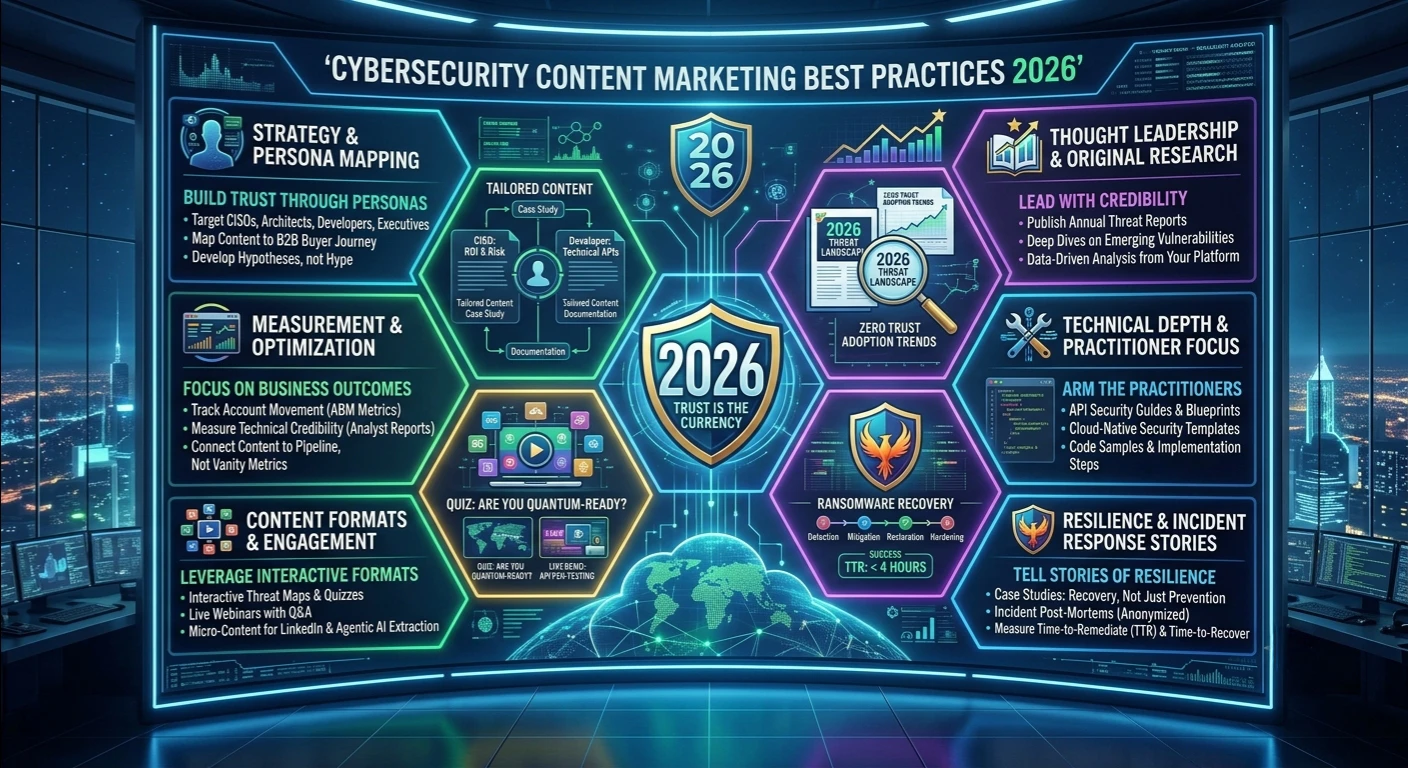
For cybersecurity companies, content marketing best practices for 2026 are crucial. They improve your online presence, build trust, and attract strong leads.
Cybersecurity is an industry that is competitive, and customers are always looking for information on cybersecurity threats, data protection, cybersecurity solutions, and security technology.
Just blogging isn’t enough. An effective cybersecurity content marketing strategy should involve audience research, keyword research, search intent, cybersecurity SEO, useful content, thought leadership, internal linking, content promotion and measuring performance.
As a cybersecurity software company, security consultant, managed security service provider, or B2B cybersecurity organization, a strategic content approach can help. It can engage prospective customers as they move through the buying journey.
Cybersecurity Content Marketing – What Is It?
Cybersecurity content marketing is the process of creating and improving content about cybersecurity. It also includes publishing and promoting content on security risks and solutions.
The objective is to not just market cybersecurity services. The objective is to inform both prospective customers and answer questions, solve issues, show knowledge and inspire trust in the target audience.
Blog posts, guides, case studies, research reports, webinars, videos, infographics, ebooks, FAQs, and checklists are cybersecurity content examples.
Businesses can reach people who search for answers, products, services, and solutions. They can do this with cybersecurity content marketing and cybersecurity SEO.
Know Your Target Audience
The most critical part of developing a successful cyber security content strategy is grasping the audience.
Each customer will have their own worries and technical expertise. A CISO may need deep knowledge of enterprise risk management. A small business owner may just want to learn about phishing, ransomware, and data security.
Audience members can include business owners, enterprise decision makers, compliance managers, security analysts, security professionals, IT directors, IT managers, or CISOs.
By gaining insight into their concerns, you can develop cybersecurity content that addresses actual queries rather than generating generic articles.
Do Cybersecurity Keyword Research
It is essential to keyword research in cybersecurity SEO. Find out what people are looking for on the web when it comes to your topics, services, problems, questions, or solutions.
Some useful keywords include cybersecurity content marketing and cybersecurity marketing strategy. You can also use cybersecurity content strategy and cyber security marketing. Consider cybersecurity digital marketing and cybersecurity SEO.
Other options include cybersecurity services and cybersecurity solutions. You may also use information security marketing and data security marketing.
Add network security marketing and cloud security marketing. Include cyber risk management, threat intelligence, and security technology.
Avoid targeting only the “big” words. Long tail keywords might be able to draw in more people who have a more specific need and intent to search.
For instance, a company can narrow its focus to “cybersecurity services” or “cybersecurity services for small businesses” or “how to choose cybersecurity services.”
Understand Search Intent
Search intent refers to why a searcher is looking for a search result. When users are reading material that has no intention of it being what they need, this leads to a disconnect between the content they are viewing and what they are looking for.When content is not intended to be what the user is looking for, there is a disconnect.
Examples of informational searches are: What is threat intelligence? or What is network security? This type of user looks for education.
Commercial searches can incorporate terms like best cybersecurity solutions or cybersecurity companies. These are users who are looking into options.
The terms used in transactional searches are more specific, like “hire cybersecurity services” or “get cybersecurity assessment.” These users are nearer to taking action.
Businesses can help prospects along the buying journey by developing content for various forms of search intent.
Build Topic Clusters
Rather than publishing articles that do not relate to one another, structure articles around key cybersecurity issues.
For instance, a cybersecurity solutions pillar page can link to articles covering network security, cloud security, data security, threat intelligence, ransomware protection, vulnerability management, incident response, and cyber risk management will provide support.
Link these pages to other appropriate internal pages.
Using topic clusters helps users find related information. It also creates a clear structure. This structure shows depth on key cybersecurity topics.
Create Educational Content
The issue of cybersecurity can be challenging to grasp and even harder for non-technical users. When you create educational content, write it so people can understand it easily. Include all important information.
For instance, if you’re talking about threat intelligence, define it, explain why organizations need it, explain the types, how organizations are using it, and how threat intelligence is helping your security teams.
Content that teaches can entice prospective buyers who might not be ready to buy. It also allows cybersecurity firms a chance to build a reputation and authority as a source of information.
Develop Thought Leadership
Thought leadership can make a brand stand out from its competitors in the cybersecurity space.
Companies can publish original research, expert opinions, security analysis, industry reports, interviews, cybersecurity predictions, threat analysis, and commentary on the latest security issues.
Rather than quoting information that is readily available on the Internet, offer original insights, practical examples, original data, and professional experience.
Properly executed thought leadership can boost brand recognition. It can also show the company understands the cybersecurity sector.
Concentrate on Cybersecurity Awareness.
Cybersecurity awareness is a great content theme—organizations are always having to teach employees and customers about security issues.
Examples of useful topics include phishing security and password security.
They also include protection from social engineering and ransomware awareness.
Other topics include data protection and secure remote working.
You can also cover employee security training and mobile security.
Cloud security awareness is another useful topic.
This type of content cater to the people who are looking for some hands-on tips and tricks on security, and it can also showcase the knowledge of a company.
Create Case Studies
Case studies include actual data on the solutions offered to solve customer problems.
The ideal case study should describe the customer’s problem, the security issues that surrounded it, the solution applied, the process completed and the outcomes obtained.
A case study is useful for B2B cyber security marketing. B2B decision makers want proof of value before selecting a provider.
Demonstrate how a cybersecurity solution resolved a real business problem instead of merely claiming it did.
Evaluate Content for SEO Optimization
Once you have created your content, make it search engine and user friendly.
Include the main keyword in the title and main heading.
Add it to the introduction and relevant subheadings.
Use it in the body text and meta description, when applicable.
Place it in the URL and image ALT tags.
Avoid keyword stuffing. The content should be spontaneous and beneficial.
When used naturally, related terms like cybersecurity content marketing and cybersecurity services can add helpful context. Other related terms include threat intelligence, data security, network security, cyber risk management, and security technology.
Use Multiple Content Formats
Blogging is not the only effective way to implement a complete cybersecurity digital marketing strategy.
White papers, ebooks, webinars, videos, infographics, podcasts, research reports, case studies, security guides, checklists and FAQs are all great options for business use.
Various formats appeal to various audiences. Some prefer detailed explanation and technical guidelines, while others want it absorbed by watching short videos or visual explanations.
Multiple formats can lead to more reach, engagement, and content distribution.
Content for the Buying Journey
In this awareness phase, users can look for general cybersecurity threats or inquire about what ransomware is.
They could be shopping around for cybersecurity solutions, network security options, or cloud security providers when they are in the considering phase.
During the decision phase, they might do research on cybersecurity providers, examine case studies, or look at certain companies.
Developing content for each stage can assist to get potential customers closer to conversion.
Strengthen Internal Linking
Internal linking interrelates related pages and assists users in navigating your website.
You can link articles about cybersecurity awareness to pages about data security, network security, threat intelligence, cyber risk management, and cybersecurity services.
You should also link new content to authoritative content already published on the website.
Internal linking provides a good sense of structure that helps with site navigation and aids search engines in understanding the relationships among topics.
Establish Trust Through Accurate Information
Trust is paramount in the world of cyber security marketing. Don’t make outlandish statements or misinformation or sensationalist messages.
Content should be: accurate, transparent, useful, and regularly reviewed.
Employing expert authors, original research, reliable references, new statistics, real-world examples and clear explanations will build credibility.
When you discuss threats, speak responsibly about the risks and offer practical advice when appropriate.
Monitor Industry Trends
Cybersecurity changes quickly. It is important for content teams to stay abreast of trends in ransomware, AI, cloud security, data protection, threat intelligence, security tech, zero trust, vulnerability management and regulatory change.
When it comes to a cybersecurity brand, there’s nothing better than publishing timely content on relevant news and developments that can make it useful and competitive.
But we should cover trends only if they relate to the audience and business and matter to them.
Measure Content Performance
Content marketing should be related to quantifiable business targets. There are key metrics that focus on organic traffic, search impressions, keyword rankings, CTR, engagement, leads, conversion rate, backlinks, return visitors, and revenue. It’s not just about traffic.
A page that gets a few high-value visits, but is very relevant to your site, can be more valuable than a page that attracts thousands of visitors, but doesn’t have any commercial interest.
Update Existing Content
Information about Cybersecurity can be rapidly outdated. Periodically review and update older content, including statistics, threat information, technology references, examples, links and recommendations.
Content updates can help to make the content more useful and accurate. Businesses should also include missing data, respond to new questions, enhance poor sections and improve internal links.
Promote Your Content
Creating content is just one aspect of a cyber security marketing plan. Leverage quality resources via email marketing, LinkedIn, industry communities, newsletters, webinars, digital PR, professional networks & niche partner sites.
In the case of B2B cybersecurity companies, professional networks may be especially beneficial for spreading research, thought leadership, case studies, and education.
Make Sure to Keep a Content Calendar
Having a content calendar is a great way to stay consistent and organized.
Add content topic, main keyword, purpose of search, target audience, format, author, publishing date, internal links, channels of promotion, update date, performance metrics.
A structured calendar can also help you identify gaps in content and prevent content duplication.
Focus on Quality
The quantity of low quality articles is not sufficient to get better results.
Ask questions before publishing to ensure that the content is answering the question, providing accurate information, showing some level of expertise, similar to what the user is searching for, and providing practical value.
To create high-quality cybersecurity content that would be helpful for people first, and easy to read for search engines, the content needs to be polished and well-organized.
Final Thoughts
Content marketing for cybersecurity best practices 2026 prioritize content that is accurate, valuable, trustworthy, and optimized for search engines to provide solutions to genuine customer issues.
The strategy that is successful is the mix of cybersecurity content marketing, cybersecurity SEO, cybersecurity awareness, data security, network security, cloud security, threat intelligence, cyber risk management, and cybersecurity services.
With these strategies, cybersecurity firms can boost online visibility and reach their target audience more effectively.
These strategies can also help cybersecurity businesses grow their market presence and connect with their audience better.
The end goal doesn’t just have to be about ranking for cybersecurity phrases. To establish a respected source for those exploring cybersecurity threats, cybersecurity technology and cybersecurity solutions. High-quality, relevant information can attract the right visitors, build authority, generate leads, and support steady company growth.