Ever wonder how do apps work every time you hit an icon on your smart phone? Mobile applications can be used to perform numerous tasks in just a few seconds, whether you are checking social media, ordering food or shopping online or sending a message. There are software, servers, databases and programming behind every successful app that plays a role in creating a smooth user experience.
It’s not a requirement to be a programmer to understand how apps work. After you know the fundamental concepts of developing mobile applications, the understanding of app architecture and communication between the mobile device and remote servers becomes much easier.
This book will show you the inner workings of mobile applications, how they work, and the essential technologies behind the mobile applications of today.
Mobile Apps
A mobile app runs on smartphones and tablets. It uses device features like the camera, GPS, microphone, storage, and notifications.
There are three types of apps:
- Native apps
- Hybrid apps
- Web apps
Apps use different technologies to deliver a fast, easy experience.
How Apps Work?
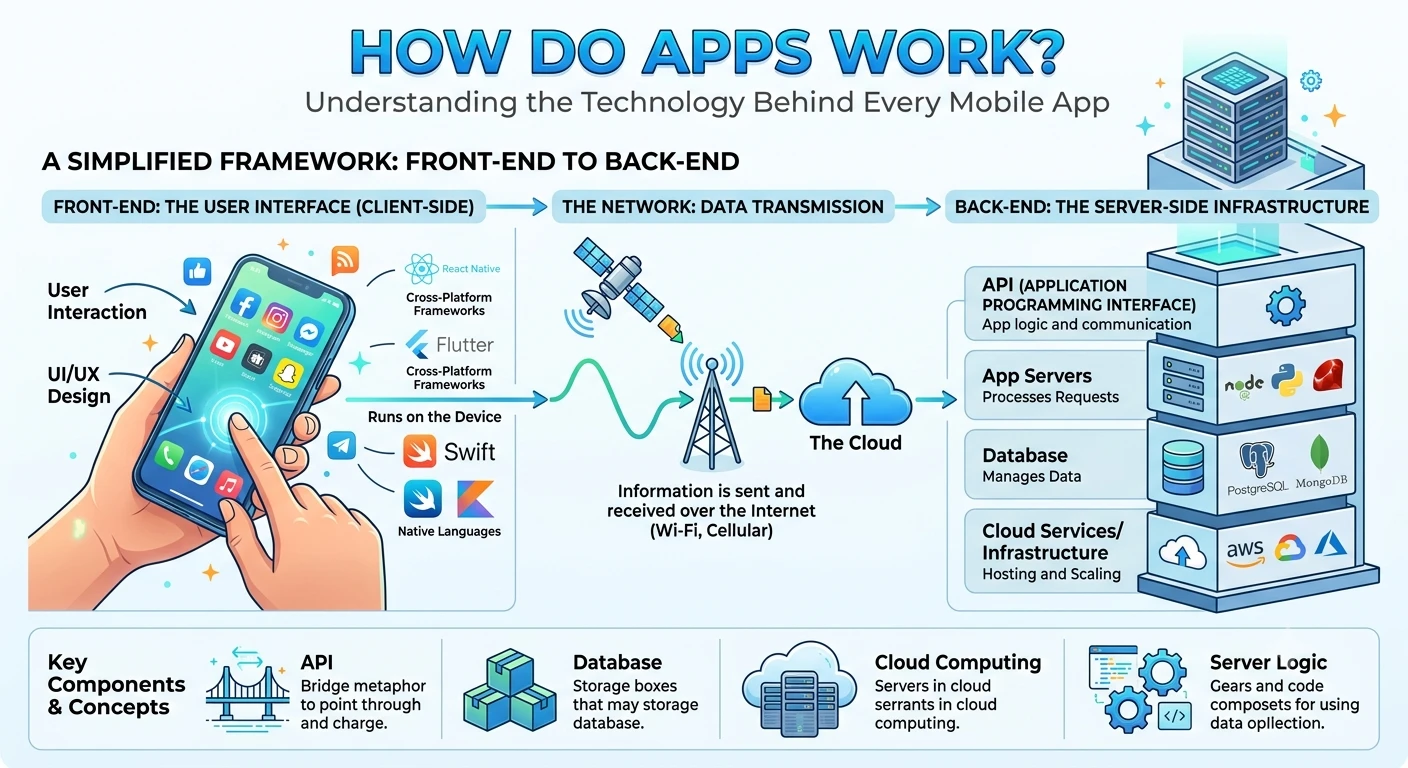
Apps take input, process it, and deliver the requested output. When you open a weather app, for instance:
- The app detects your location.
- It calls a weather server via an API.
- The server looks in its database.
- The weather has returned.
- The app shows the weather forecast on your screen.
This should take place in seconds, creating an instant experience.
App Architecture
Each application uses an app architecture to connect its different components.
The typical structure of most modern applications is three layered:
Frontend
The frontend is that part of the website that your users will interact with and see. The interface includes buttons, menus, animation, forms and images.
A good frontend gives a seamless user experience and makes the app easily navigable.
Backend
The mobile app backend handles all behind-the-scenes processing. It handles the logic of a business, saves the data of its users, checks accounts, deals with payments, and interacts with databases.
If it wasn’t for the backend, many of the modern applications wouldn’t work.
Database
Here are some of the key data that is stored in the database:
- User accounts
- Passwords
- Product listings
- Messages
- Images
- Order history
- Settings
The app connects to the database when users log in or get their saved data.
Frontend vs Backend
The most crucial idea in the front and back end is that the front and back end have different responsibilities.
Frontend developers are tasked with paying attention to:
- User interface
- Navigation
- Design
- User interactions
The backend developers are responsible for:
- Servers
- Databases
- APIs
- Authentication
- Business logic
- Security
They both work together to make a full application.
Client-Server Model
Client server architecture is the most common architecture for mobile applications. The smartphone is the client.
The server is the main computer which holds data and conducts calculations.
On pressing a button:
- The client registers a request.
- The request is processed on the server.
- A response is returned from the server.
- The result is displayed in the app.
This is communication via the Internet.
API Basics
API integration enables various software application systems to communicate with each other.
An API can be compared to a waiter in a restaurant.
- You place an order.
- The waiter takes it to the kitchen.
- The food is cooked in the kitchen.
- The waiter brings it back.
Similarly:
- A request is sent via the app.
- It is passed to the API.
- It is processed on the server.
- The API returns this response.
There are a number of apps that rely on APIs for:
- Maps
- Weather
- Payments
- Login systems
- Social media sharing
Development Process
There are a number of important stages in the development of the app.
Planning
Developers define:
- Purpose
- Features
- Target audience
- Platform
Design
Wireframes and UI designs are created by designers.
Development
Frontend and backend systems start to be programmed.
Testing
Developers identify bugs and correct errors to enhance performance.
Deployment
The completed app will be released for sale at the app stores.
Maintenance
Regular updates enhance security, resolve bugs and add new features.
Programming Languages
Depending on the platform, different languages can be used for programming.
Android commonly uses:
- Kotlin
- Java
iOS commonly uses:
- Swift
- Objective-C
Cross-platform development typically involves:
- Flutter
- React Native
- Xamarin
There are benefits to each language for developers.
Native vs Hybrid Apps
Native Apps
Native apps are applications that have been developed for one operating system.
Advantages include:
- Faster performance
- Better security
- Full hardware access
- Smooth animations
Disadvantages:
- Higher development cost
- Different code bases for Android and iOS.Different code base for Android and iOS.
Hybrid Apps
Hybrid app development is the development of a single codebase for multiple platforms.
Advantages:
- Lower cost
- Faster development
- Easier maintenance
Disadvantages:
- Slightly slower performance
- Limited hardware optimization
Hybrid apps are often selected by businesses to achieve more users, but at a lower development cost.
App Frameworks
A mobile application framework supplies the developer with the devices and re-usable code.
Popular frameworks include:
- Flutter
- React Native
- Ionic
- Xamarin
Consistency across devices, and speeding up development with frameworks.
Cloud Apps
Whereas many modern applications do not store everything on the device, and instead use cloud-based applications.
Benefits include:
- Automatic backups
- Real-time synchronization
- Faster updates
- Remote data storage
- Better scalability
Users can view their data from any device with Cloud technology.
App Hosting
The app has to be hosted on every backend. Hosting companies maintain and manage servers, storage, and network resources, which keeps applications up and running 24/7.
Reliable hosting ensures:
- Faster loading times
- High availability
- Better security
- Stable performance
App Lifecycle
The mobile app lifecycle is the process that takes a mobile app from its conception to its termination.
Typical stages include:
- App launch
- Active use
- Background operation
- Resume
- Shutdown
Efficient lifecycle management helps maintain battery life and enhances battery performance.
Databases
With good database management, apps are able to fetch information in a timely and secure manner.
Popular databases include:
- MySQL
- PostgreSQL
- MongoDB
- Firebase
An efficient database can enhance website loading speed and user experience.
App Security
A major feature of an app’s function is security. Applications are protected by the developers by using:
- Encryption
- Secure authentication
- Firewalls
- Data validation
- HTTPS connections
- Multi-factor authentication
Regular updates protect users from new vulnerabilities.
Performance Optimization
Apps should load almost instantaneously. There are many ways that developers improve performance, however some of the most common are:
- Compressing images
- Reducing unnecessary code
- Optimizing databases
- Using content delivery networks
- When using the Data Manager, items that are used often are saved in the cache.
Optimization results in better user satisfaction and App ratings.
Future of Mobile Apps
Mobile apps are still rapidly changing, with new technologies such as:
- Artificial Intelligence (AI)
- Machine Learning
- Augmented Reality (AR)
- Virtual Reality (VR)
- Internet of Things (IoT)
- 5G connectivity
Future applications will be faster, smarter and more personalized than ever before.
Conclusion
Learning how do apps work will help you appreciate technology in the apps you use every day. Each mobile application, whether it’s frontend design, backend processing, databases, APIs, cloud services, or secure hosting, provides a seamless user experience. Modern apps use efficient programming to perform complex operations in seconds, whether built as native or hybrid applications. In the future, mobile apps will be even more intelligent, secure and integral to our lives, and will be one of the most impactful innovations of the digital age.