Digital commerce reaches another growth stage where artificial intelligence not only assists users but also makes decisions on their behalf. This approach, called agentic commerce, uses intelligent systems to autonomously search for, compare, and purchase products. Understanding how marketplaces can prepare for agentic commerce is becoming a strategic priority for platforms that want to stay relevant in an increasingly AI driven world.
In agentic commerce, intelligent shopping agents shop on behalf of users, unlike traditional e-commerce, where customers browse websites themselves. These agents are based on data, logic and timely insights to finalize the transactions effectively and correctly.
What Is Agentic Commerce and Why It Is Important?
The driving force of agentic commerce is agentic AI, which allows the current AI agents to make autonomous choices in respect of goals, preferences, and situations. With the aid of such AI systems, a user can explore products, compare options, and even use the system to make purchases without the need to be attended to by a human being at all times.
This model does not require AI agents to operate under direct control. Instead, it continuously optimizes purchase history, trend analysis, and decision-making over time. As customers increasingly rely on automation for convenience, businesses should create shopping experiences that align with AI-driven shopping behavior.
The Shift Away from Traditional E Commerce
Traditional e commerce platforms are designed for human users. The focus of their design is on the visual design, manual filters, and step-by-step navigation. However, agentic commerce requires a different foundation. AI agents do not search visually, but they use machine readable and well organized information.
In order to be competitive, marketplaces should stop being human-centered with interfaces and shift to systems that would enable agents to operate on behalf of users efficiently. Those platforms which will not do that will lose their visibility because AI agents are going to become the latest decision-makers.
Development of Agent-Ready Product Data
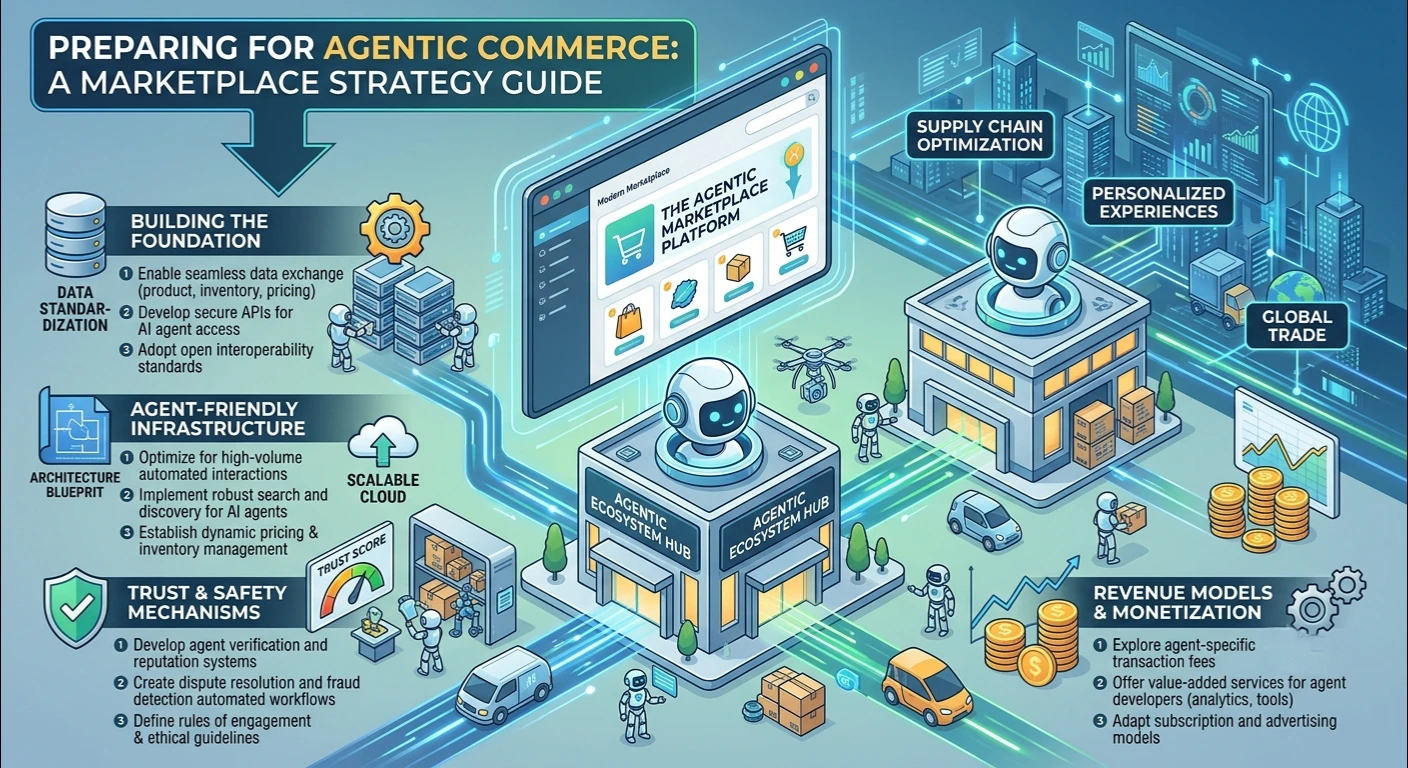
High-quality product data builds the foundation of agentic commerce. Intelligent agents use accurate, consistent, and detailed information to make reliable purchase decisions. Marketplaces must ensure their listings support automated understanding.
Key elements include:
- Easy and uniform product features.
- Normalized classifications and specifications.
- Open prices and availability.
- Proper information on sellers and warranty.
Use structured data because artificial intelligence software can easily access and interpret the information. Properly structured data makes content fully machine-readable, allowing AI to recommend products faster and more accurately.
The Discovery of Products in AI Agents
Product discovery in agentic commerce occurs via algorithms as opposed to manual searching. AI agents search through massive data sets to determine the most suitable options to the users depending on tastes, finances and contexts.
In order to enable agents:
- Internal systems need to improve in marketplaces.
- Find the products of interest instantly.
- NarrowRadar The search criteria can be used to filter results.
- Compare features that are offered by different sellers.
With well-structured marketplaces, whose discovery is effective, it becomes possible to find opportunities quickly and therefore increase the speed and quality of decisions made by the shopping agencies.
Going Purchase History to make Smarter Decisions
Among the greatest merits of agentic AI, the possibility to learn data is present. The history of purchases is an important factor that assists AI agents in forecasting future preferences and demands.
Through making previous transaction analyses, AI agents can:
- Automate repeat purchases.
- Telesign recommended improvements or substitutes.
- Project anticipated needs ahead of schedule.
By markets that safely store and share this information, there is an opportunity to make the interaction experience between the agent more personalized and accurate, resulting in higher customer loyalty.
Furthering Agents That Act on Behalf of Users
A transaction can occur without the involvement of the users in the agentic commerce. This implies that market places should be able to aid in environments where the agents are able to act on behalf of the customers in a safe and transparent way.
In an attempt to attain this, platforms must incorporate:
- Safe authentication of AI agents.
- Easy authorisation on amounts of spending.
- It has open transaction records.
Trust is critical. When end users are made to believe that AI agents are operating in their best interest, automated shopping is significantly adopted.
The implementation of Intelligent Shopping Assistants
A current-day market place needs to be in alignment with platform-agnostic shopping assistant technologies. They include tasks like selection of products, comparison of prices, and placing orders, among others, they are assistants.
A useful intelligent assistant will be able to:
- Evaluate several markets simultaneously.
- Choose the most appropriate value in the view of the user.
- Register deliveries and handle returns.
Supporting such assistants, marketplaces make them look like agent ready and become available in larger systems in the world of AI.
Preparing the Supply Chain for Agentic Commerce
Client Georgic trade does not have a customer interface alone. The supply chain should also adjust itself to real-time and automated buying patterns.
AI agents are based on proper logistics data. Marketsplace must concentrate on:
- Live product tracking of inventory.
- Semi-automated order fulfillment.
- Trustworthy shipping quotations.
With an AI powered supply chain, it is possible to save time in the supply chain and eliminate errors that could occur when agents make their purchases.
Facilitating Smoothing Agent Interacting Systems
To be an agentic commerce with this scale, marketplaces should be open to agent interacting via API and system integrations. AI agents should have direct access to product catalogs, price systems, and order processing systems.
Markets that are normalised using access controls develop a linked ecosystem in which intelligent agents can run efficiently on various platforms.
Transparency and Ethical Appeals
The more the AI agents control the purchasing process, the more transparency is needed. Users should be aware of how they make recommendations and what makes some products be selected.
Marketplaces should:
- Fully articulate logic of pricing.
- Publicize the policies of using data.
- Make sure that there is healthy competition amongst the sellers.
Moral AI activity is useful in creating long-term confidence in the ai-based business setting.
The Future of the Marketplace in an Agent’s Economy
Agents business is a radical change in the way individuals are shopping over the internet. Marketplaces that understand how marketplaces can prepare for agentic commerce will lead this transformation rather than react to it.
Investing in structured data, agent compatibility, intelligent supply chains, and secure automation enable platforms to go beyond the old implementations of e commerce and prosper in a future where agent oriented shopping experiences prevail.
With agentic AI still developing, the marketplaces that become agent ready to the fullest extent will not only appeal to a larger number of people but it is also becoming the place of choice where people use AI-powered buying decisions.
Conclusion
Agentic commerce is reshaping digital marketplaces by enabling AI agents to search, compare, and purchase products on behalf of users. Marketplaces that focus on structured data, agent-ready systems, and transparent processes will stay competitive in this AI-driven era. By supporting intelligent shopping assistants and improving product discovery, platforms can deliver faster and smarter experiences. Becoming agent-ready today will help marketplaces succeed in the future of automated commerce.