
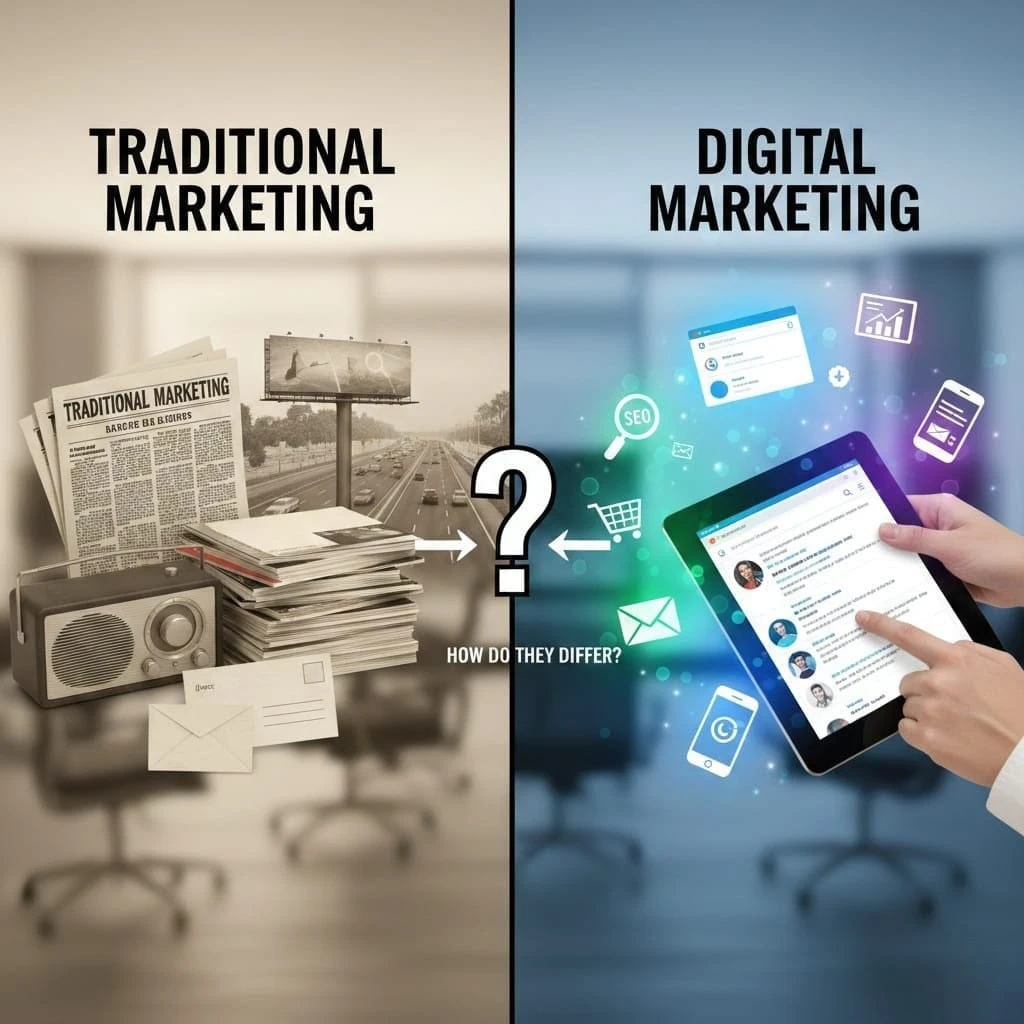
The concept of digital marketing being different from traditional marketing is critical to the growth of businesses that desire to adapt in the rapidly evolving environment.
The two approaches are both working towards product promotion, as well as reaching the customers. Nonetheless, the strategies, tools, and outcomes are very different. Since the behavior of consumers changes, the brands have to know the fundamental distinctions in order to select the appropriate style.
This guide covers every method and identifies the most significant differences in order to make the most informed decisions.
What Is Traditional Marketing?
Traditional marketing has been known as promotional activities that are implemented via offline channels. These are television advertisements, radio announcements, billboards, print newspapers, brochures, and direct mail. These approaches have been used by businesses for decades. Conventional marketing is concerned with the wide coverage. It is effective in brand visibility, and it makes a long-term impression because of its physical and visual presence.
But conventional marketing is prone to high budgets. It also has limited tracking since the business does not have a chance to gauge the individual response of the customers. Even though it does not lose its value, it is often used alongside digital approaches by various brands that want to remain relevant.
What Is Digital Marketing?
Digital marketing is an online promotional effort that is conducted via the digital medium. Such mediums are social media, websites, search engines, email marketing, mobile applications, and online ads. Digital marketing is based on information, analytics, and live communication. It provides businesses with the opportunity to monitor audience behavior, measure outcomes, and conduct personal campaigns.
This approach has increased at a large pace because of the advent of smartphones and the internet. It enables the brands to interact with the audiences in real time. It is also flexible, cost-controllable and has measurable results. Consequently, it has made digital marketing a critical component of the current business strategy.
Major Differences between Digital and Traditional Marketing
The main differences between digital and traditional marketing can be explained by comparing their essence. Such disparities are the reason why most companies are moving towards digital distribution.
1. Audience Targeting
There is a large audience when it comes to conventional marketing. As an example, a TV commercial targets anybody who happens to be watching the television channel. A billboard targets any person who passes by the road. It is a good mass but not that specific a strategy.
The internet marketing offers advanced targeting. Demographics, interests, behaviors, and online activity allow Facebook and TikTok, as well as Google and others, to ensure that the content reaches the right audience. This will help the businesses to filter only those customers to whom there is a better chance of making a purchase.
2. Cost and Budget Control
The traditional marketing campaigns are usually expensive in terms of budgetary allocation. TV advertisements, radio advertisements, and newspaper advertisements can be expensive. The more the frequency and the visibility, the more the price. Small business enterprises are typically at a disadvantage in competing with limited resources.
In digital marketing, you can feel like spending anything. It is possible to start with small amounts and pay more for performance. Pay-per-click marketing allows you to pay money every time somebody takes action on your advertisement. This will help in maximizing spending and eradicating extravagant costs.
3. Tracking and Analytics
One of the most significant differences between digital and traditional marketing is the fact that it is possible to monitor the results. The traditional campaigns are not very specific in the measurement. It is possible to guess impressions but not make any concrete calculations.
The digital marketing provides you with real time analytics. You can also monitor the clicks, impressions, conversions, time taken on the site, and the activities of a user. The tools such as Google analytics and social media insight give comprehensive reports. It will help you to make evidence-based decisions and improve the work of campaigns.
4. Customer Engagement
The traditional marketing follows a one-way channel of communication to a large extent. Ads are put across and the audience picks them up. There is little and slow communication. A customer responding to one of the newspaper advertisements may take days, as an example.
It is because of digital marketing that there can be two-way communication. Customers can comment, send messages, react, and communicate in real time. Companies can respond to questions, solve issues, receive feedback and build confidence in a real time. Communication improves consumer loyalty and creation of communities.
5. Speed and Flexibility
Traditional marketing takes a longer time to develop. It takes weeks to develop a billboard or a TV commercial. The change/ update of the campaign is not easy and costly.
Online marketing is fast and dynamic. Ads on the Internet can be created within few minutes and launched instantly. When the results are poor then you can break or modify the campaign on the spot. This flexibility will allow the brands to react quickly to trends.
6. Reach and Accessibility
The conventional marketing is highly localized. It works with the local populations through the local newspapers, flyers, and outdoor advertisements. However, it is more challenging to reach foreign clients.
Online marketing is worldwide. Your content can be accessed by any internet user. Small businesses will be at a position of being able to venture internationally without necessarily opening shops. This accessibility boosts online marketing in the long-term development.
7. Personalization
Conventional marketing does not have a high level of personalization. The same content is viewed by all the viewers. The message remains generic since it is appealing to a large audience.
Digital marketing offers very personalized experiences. It is possible to send various messages to various audiences. As an example, a Web store can provide certain product suggestions in terms of the work on products. Catering to individual needs enhances satisfaction and higher conversions.
8. Communication in Multiple Formats
The standard marketing channels are mostly of a fixed format, such as print, audio, and visuals. These are good formats that are restricted.
There are unlimited formats of digital marketing. These are videos, blogs, podcasts, infographics, advertisements, landing pages, emails, and interactive media. Catchy designs appeal and convey information in appealing ways.
9. Conversion Rates
Online campaigns can have a better conversion. Customers can use ads, open websites, and purchase products in real time. The whole assimilation process takes place via the Internet.
Conventional marketing involves physical action. Customers have to go to stores or to call numbers, which decreases the chances of instant conversions. This will streamline digital marketing for those companies that want to achieve fast outcomes.
What is Best for Your Business?
The other question that arises now that you are aware of the digital marketing and traditional marketing differences is which one you should adopt. Both have unique advantages. The traditional marketing is the most appropriate in the respect of brand image creation and locality awareness. It works in massive events, offline viewing, and long-term brand memory.
The use of digital marketing would be best to capture the targeted segments, generate leads, and increase online sales. It offers efficient analytics, accurate tracking, cost management, and fast execution of the campaign. Most of the successful brands use both approaches together so as to have the most impact.
The Final Words
In conclusion, traditional marketing is more of reaching a large number of individuals, being in the real world, and having long-term impacts. Digital marketing is focused, personal, analytical, and economical.
Because the trend of consumer behavior is shifting to the online platform, a blend of the two strategies could establish an effective and balanced marketing strategy. Through sound thought process and data-driven action, businesses can build stronger relationships and better performance.