

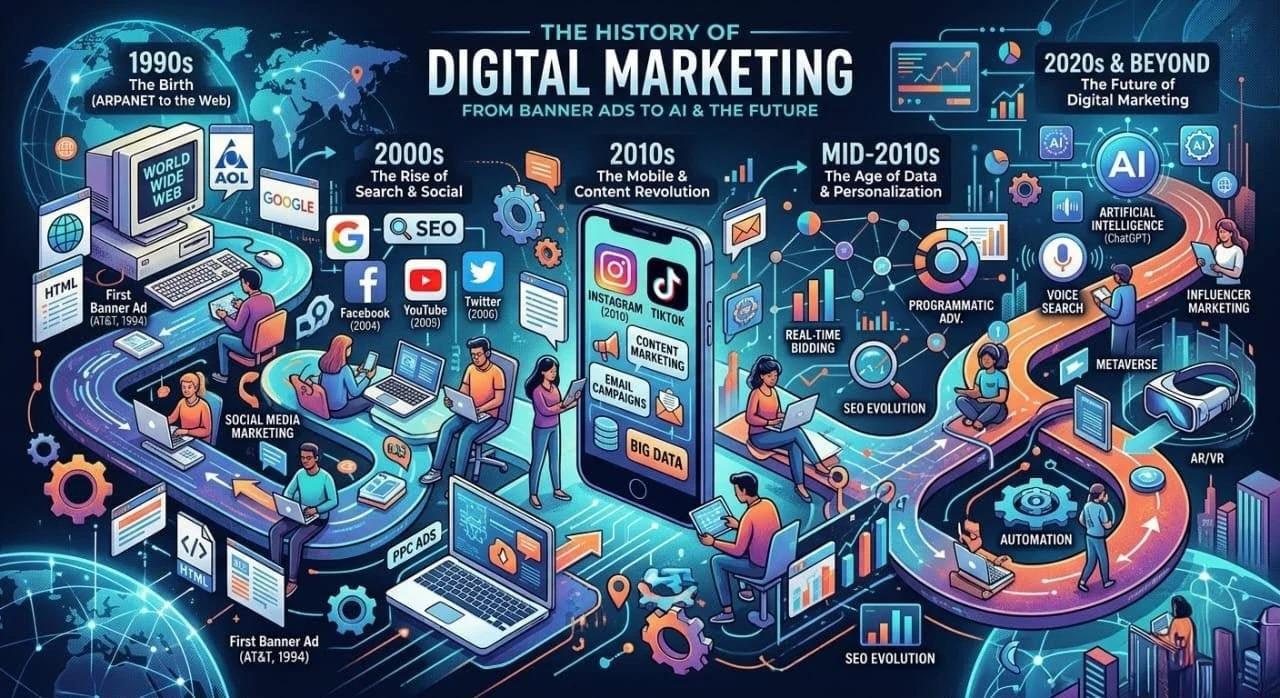
The history of digital marketing is closely connected to the development of technology and the way people communicate. With the proliferation of the internet and the introduction of digital channels into our lives, marketing changed as well. Companies shifted towards not using the customary way of marketing to the digital platform that enabled customers to interact with them in real time. The knowledge of this journey can assist the marketers to trace the evolution of digital strategies and where the future of digital marketing is taking.
Digital marketing has not emerged in one day. It is the conclusion of decades of technological creative imagination, shifting consumer patterns, and new instruments that shifted the manner in which brands market products and services. From the rise of the world wide web to the dominance of mobile devices and artificial intelligence ai, every stage has shaped modern marketing strategy.
The Digital Communication and the Birth of the Internet
The foundation of digital marketing was laid with the creation of the world wide web by Tim Berners-Lee. This is the breakthrough that saw information shared all over the world via intertwined computers. With the increased prevalence of websites, companies were able to understand that they can use this alternative space to connect with a wider audience than what was available in the physical space.
Early digital marketing efforts were simple and mostly informational. Firms developed the simplest web pages that presented their brand and services. Digital media was predominantly utilized at this point in time as an online brochure but this turned out to be the start of a significant change in the history of marketing.
The Rise of Search Engines and Search Engine Optimization
As more websites appeared, search engines were developed to help users find relevant information. This transformed the way individuals used the internet and gave business new opportunities. The companies could position themselves at the point where customers were already searching as opposed to having the customers find them after using the site.
This period saw the emergence of search engine optimization. Companies started to optimize their web pages to be ranked higher in the search. The role of SEO as an important element of online marketing was explained by the ability to attract organic traffic and not pay to get each visitor. The history of digital shows that SEO was one of the first structured digital marketing tactics and remains essential today.
Email Promotion and Online Early Advertising
Within very short time, email was a favorite digital communication medium. Marketers realized that it has direct contact with customers. Through email campaigns, businesses were enabled to share promotions, updates and individual messages thus making marketing more specific compared to traditional advertising.
Meanwhile, banner advertising and early internet advertising emerged on the websites. These ads introduced the concept of clickable promotions, which allowed marketers to measure results more accurately than traditional marketing methods. Tracking clicks and impressions helped businesses refine their marketing strategy and improve performance.
The Social Media Digital Marketing Evolution
The introduction of social media sites changed digital marketing dramatically. Social interaction sites were strong marketing tools. There was the ability to communicate directly with users, create communities and promote interaction in brands.
The social media marketing enabled organizations to disseminate contents, conduct paid advertisement campaigns and engage in real time interaction. This made marketing more of a dialogue as compared to one-way communication. Customers could comment and provide opinions and shape up brand reputation in real time. This step was a significant step of development in the sphere of digital marketing.
Mobile Technology and Marketing on the Go
The increase in the use of the mobile phone and subsequently smartphones changed the manner in which individuals accessed the internet. The desktop computers were not the only available ones to the users anymore. Mobile devices allowed constant connectivity, which changed consumer behavior and expectations.
Marketers accommodated it through the development of mobile-friendly websites and smaller-screen campaigns. New engagement opportunities were also presented by the development of the mobile app market. Digital marketing involved push notifications, in-app advertisements, and location-based marketing.
Marketing could be more immediate and personal than ever before due to mobile technology.
Real Time Personalization and Data-Driven Marketing
The data collection and analysis became better as digital platforms developed. Marketers could now track user behavior, preferences, and interactions across multiple digital channels. This resulted in the increased precision of targeting and personalization.
Real time marketing became possible, allowing brands to respond instantly to user actions. As an illustration, certain firms could show specific advertisements, basing on the history of browsings or email notifications, basing on customer activities. Evidence-based decision-making reinforced the efficiency of digital marketing as well as assisted the firms to align the campaigns with the marketing objectives.
Content Marketing and the Growth of Digital Media
Content marketing has become one of the important aspects of digital marketing. The brands started to create content of value which they sell such as blogs, videos and guides rather than merely conducting promotions.
Such a strategy creates confidence and places companies as valuable services. Digital media websites facilitated easy distribution of content to numerous people. Good content enhances search engine optimization, social media marketing, and email marketing. Over time, content marketing has developed to be one of the most useful ways of attracting and keeping customers.
Artificial Intelligence in the Sphere of the Modern Marketing
Recent digital marketing has been powered by artificial intelligence ai. The solutions based on AI analyze large amounts of data to predict the behavior of users, automatize processes, as well as optimize campaigns.
Some of the ways AI can be used to improve efficiency include chatbots, recommendation systems, and automated ad platforms. With the help of such technologies, marketers will be able to deliver more relevant messages and provide customers with better experiences. The future of digital marketing is controlled by AI which makes campaigns smarter and more adaptive.
Unified Strategies and Multichannel Marketing
The digital marketing lacks a single platform in the present. Businesses use multiple digital channels, including search engines, social media sites, email, and mobile apps, as part of a unified strategy.
With omnichannel marketing, brand experience is uniform. Customers may discover a brand through social media, research it on a website, and make a purchase through a mobile app. Integrated strategies reflect how the history of digital marketing has moved toward seamless connectivity.
The Digital Marketing Future
Technology and consumer expectations will still define the future of digital marketing. Some of the emerging technologies that will avail the brands of new opportunities to interact with them are voice search, sophisticated AI and augmented reality.
The main concerns will be personalization, automation, and privacy of data. Digital marketing change that is being presently observed proves that flexibility is the secret to the long-term success.
Conclusion
Digital marketing has been a narrative of the unrelenting evolution of technology and human beings. From the early days of the world wide web to the rise of mobile devices and artificial intelligence ai, each stage has expanded what is possible in marketing.
Being aware of this history, companies can admire the manner such digital marketing strategies developed, and how they can be exploited today. As the digital channels continue to change, the knowledge gained in the past will enable the marketers to be more creative and successful in the future.