
Do you find yourself ever developing content continuously, but like your brand is not growing anymore? You’re not alone. Most companies indulge in the content game, and post-blog, video and social updates without a roadmap. This fallacy leads to one of the core misconceptions between two essential yet different concepts: content strategy and content marketing.
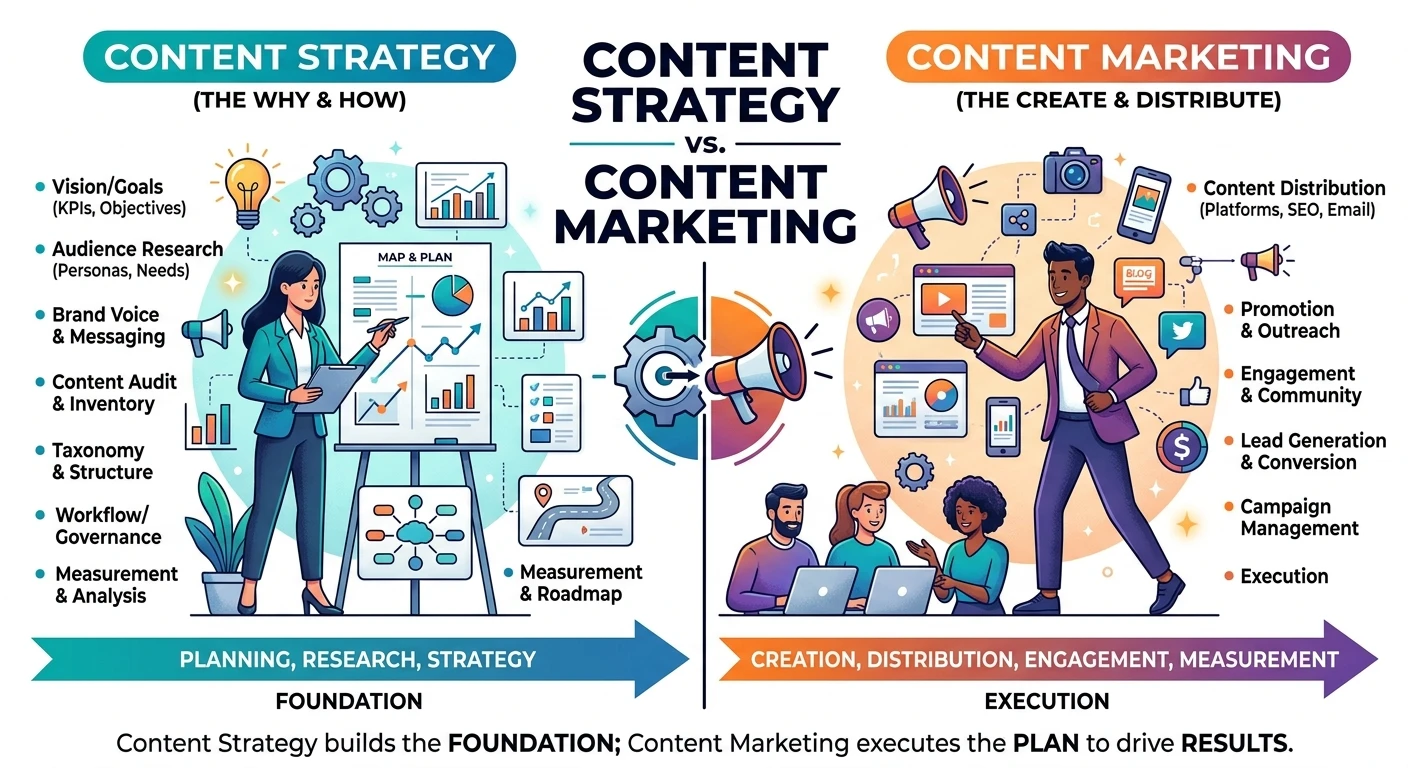
Although they are two inseparable concepts, they do not mean each other. Consider it in terms of the following: the first one is the blueprint, and the other one is the construction crew. You will not begin a house without a blueprint, will you? In the same way, you cannot create a successful brand without a content strategy to direct your content marketing campaign.
This guide will remove the confusion between the two terms, clarify how they interact, and provide you with an actual idea of how to create a strong framework capable of meeting the requirements of the modern search engines, including the much-desired E-E-A-T signals.
The Blueprint of Content Strategy
A content strategy will determine the purpose behind your creation of content, the audience, what you will talk about and the alignment of the content to your business objectives. High-level planning is what makes sure that each and every piece of content that is published has its purpose, and can help you in your bottom line.
What is a Content Strategy?
Content strategy is basically the planning and control of content in the lifecycle of its existence. It provides responses to the important questions:
- Goal Alignment: What are the business aims that this content will serve (e.g. lead generation, brand awareness, customer retention)?
- Audience: What are your dream customers (buyer personas) and what are their needs, pain points and questions?
- Value Proposition: What are the things that your content brings that your competitors do not have?
- Format & Channels: What content (text, video, audio) and channels (blog, YouTube, social media) are you going to use?
The end result of a content strategy is the establishment of a foreseeable system. The system provides the appropriate information to the appropriate individuals at the right time, which encourages trust and authority.
Experience: The Power of First Hand Knowledge
Google has added the element of Experience to the E-A-T framework (it is now E-E-A-T) which greatly alters the game. Experience implies having a first hand experience of the subject. Real-life insights will need to be factored in your content strategy now.
This is much more than mere fact. It means including:
- Self anecdotes or stories of your business life.
- First-hand case studies containing real outcomes.
- How we worked with tutorials or reviews.
E.g. A financial blog does not simply describe what a Roth IRA is; the writer documents his or her experience of funding one, with screen shots (where applicable) and his or her own lessons learnt. This first hand experience creates a strong trust.
Content Marketing: The Engine of Implementation
When strategy is blueprint, content marketing is the process of making, publishing and promoting the content. It is the working part – the day-to-day business of getting your message to your audience.
The Role of a Content Marketing Strategist
Another question is usually common, what is a content marketing strategist? Such a person (or group) helps to connect the top-level strategy to daily activities. They do not only write, they control the process.
A strategist has the following responsibilities:
- Editorial Calendar Management: Planning of production and publishing.
- Optimization of the search engine: NLP, LSI, and focus keys in drafts.
- Distribution: Squeezing content out on different platforms (email, social, paid advertisements).
- Performance Analysis: Keeping track of such metrics as traffic, engagement, and conversion rates to inform the strategy.
The rubber meets the road at content marketing. It makes the strategic vision a lived-in blog posts, downloadable guides, interesting videos, etc.
A Focus on Promotion
Having good content is not sufficient, it should be advertised. According to statistics, this urgent necessity is justified: 9 out of 10 companies address content in their marketing practice, and only those who are actively promoting their activity achieve visible outcomes. The process of content marketing involves an attempt to make your content visible.
As an example, an excellent article about mobile content marketing strategy should be shared in places where people are using their mobile devices, Instagram Stories, Tik Tok, or even through SMS campaigns, rather than just sitting on your desktop-friendly blog.
Content Strategy vs Content Marketing Strategy: The Synergy
The real magic is uniting them as one great couple instead of perceiving this as a debate between content strategy vs content marketing strategy.
| Feature | Content Strategy (The Why and What) | Content Marketing (The How and Where) |
| Focus | Business goals, audience analysis, and content themes. | Creation, publication, and promotion of content. |
| Timeframe | Long-term (6-12+ months). | Short-term (daily, weekly, monthly tasks). |
| Output | Mission statement, brand voice guide, style guide. | Blog posts, social media updates, videos, email newsletters. |
| Primary | Metric Revenue impact, cost efficiency, brand perception. | Traffic, engagement, leads/conversions per campaign. |
The plan offers the baseline, which will ensure that you make the appropriate content. Its marketing makes it reach the correct individuals. When they collide, your brand has sustainable growth.
Content Marketing Strategy Checklist E-E-A-T
The creation of quality and search engine friendly content needs to be systematic. This content marketing strategy checklist is good to make sure that you cover all the required ticks, especially when it comes to E-E-A-T signals.
1. Expertise and Authoritative.
- Author Bios: Have an author bio on every content, and make sure to include their qualifications, relevant experience and awards or any form of recognition. Connection to their social networks (and LinkedIn, in particular) and an author page.
- Sourced Data: It is advisable to use statistics that are research-based and reference credible sources with the correct external links. Did you know? HubSpot established that half of the marketers intend to invest more in content marketing in 2024, which proves the confidence of the market in the mentioned approach.
- Originality: Do not simply re-use search results. Include original graphics, analysis and data, which are unique and original.
2. Learning and Reliable Character
- Personal Instances: Use examples out of real life in your work. Give an example of something that went wrong during a campaign or a list of steps followed during a successful project within the company.
- Clarity and Transparency: Who owns the website is made clear, offers easy access to a contact us page and makes all the data accurate and up to date. The links are broken, and the trust is killed immediately.
- User-Centric Design: It should be fast loading with perfect mobile experience, particularly at this time when most of the traffic through web sites is via mobile devices since more than 60 percent of the users are on the mobile platform.
3. SEO and Readability
- Key-word optimization: The focus keyword (content strategy vs content marketing) should be used in the natural way. Add (LSI) Latent Semantic Indexing keywords such as strategic content planning, marketing execution and brand building.
- Active Voice: Write aggressively. Rather than, The content was written by the team, say, The team wrote the content. This makes the speed quick and the reader on the move.
- Transitional Words: Transition your reader through such words as therefore, consequently, furthermore, however, and for example. This plays a very important role in making it readable to all age brackets.
Adopting Strong Content Strategy vs Content Marketing Framework
You know now, how to get out of publishing. You are willing to make the framework that literally constructs your brand.
Begin by identifying the main content needs of your audience, the things that they frantically seek. Then, develop a 12-month plan, based on the need fulfillment with professional, old-fashioned, and credible content. Lastly, implement an active marketing strategy that publishes that content and evaluates its effect throughout the process.
This is the difference between a brand in distress and a leader in the market: a leader has a strong content strategy, and the content marketing department is just an implementer of the established plan. This difference is something to welcome to the world, and your brand authority will fly.
Conclusion
Knowledge of content strategy vs content marketing will turn your operations into more than a one-time cost. Are you willing to make a step back and formulate the clear strategic objectives that will ultimately make your content profitable?